


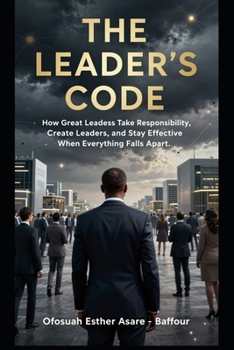
THE LEADER'S CODE - Part I: How Great Leaders Take Responsibility, Create Leaders, and Stay Effective When Everything Falls Apart

The Leader's Code argues that leadership is not about power, position, control, or charisma. It is about responsibility, influence, and making other people capable of succeeding without you.
The book's central principle is simple:
Take ownership → build trust → develop people → distribute responsibility → create leaders → build an organization that can survive without you.
1. Take ResponsibilityGreat leaders don't blame circumstances or people. They ask, "What part of this can I own and improve?" Accountability starts at the top.
2. Build DisciplineLeadership requires consistency. Keeping promises, maintaining standards, preparing properly, controlling emotions, and doing what must be done create reliability-and reliability creates trust.
3. Build TrustPeople follow leaders they trust. Trust grows through honesty, competence, consistency, listening, and admitting mistakes. When trust breaks, leaders must acknowledge reality, accept responsibility, correct the problem, and demonstrate change.
4. Stop Controlling EverythingWeak leadership creates dependency: everyone waits for the boss. Strong leadership creates ownership: people understand the mission, make decisions, solve problems, and accept responsibility.
The progression is:
"Tell me what to do." → "Here is what I recommend." → "Here is what I intend to do."
5. Develop Leaders, Not FollowersThe greatest leadership multiplier is teaching people to think rather than simply giving them instructions. Your knowledge should become their knowledge, your standards should become team standards, and your judgment should eventually become organizational capability.
6. Empower-but Maintain StandardsAutonomy without competence creates chaos. Trust without accountability creates weakness. Great leaders balance freedom with responsibility, empowerment with standards, and compassion with accountability.
7. Listen and CommunicateCommunication isn't measured by what the leader says; it is measured by what people understand. Great leaders listen actively, seek dissent, verify understanding, and stay close to the frontline where valuable information often exists.
8. Prepare for CrisisCrisis reveals whether leadership development actually worked. If the organization collapses when its leader disappears, dependency has been created. If people can think and act without the leader, distributed leadership has been created.
9. Protect the MissionLeaders must put the mission above ego, popularity, personal reputation, and short-term convenience. Strategy can change; principles should not be abandoned simply because circumstances become difficult.
10. Build a Legacy That Outlives YouThe ultimate goal isn't to become indispensable. It's to become scalable.
A leader's greatest achievement isn't what they personally accomplish. It's the people they develop, the culture they establish, the successors they prepare, and the capability they leave behind.
The final question of the book is:
"How many people became leaders because I did?"
That is the true measure of leadership.
Customer Reviews
ThriftBooks ® and the ThriftBooks ® logo are registered trademarks of Thrift Books Global, LLC
