


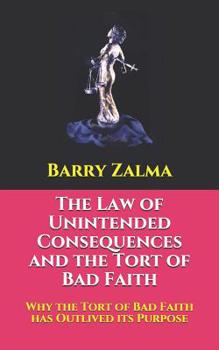
The Law of Unintended Consequences and the Tort of Bad Faith: Why the Tort of Bad Faith has Outlived its Purpose
No Customer Reviews

The concept of unintended consequences is one of the building blocks of economics. Adam Smith's "invisible hand," the most famous metaphor in social science, is an example of a positive unintended consequence. Most often, however, the law of unintended consequences illuminates the perverse unanticipated effects of legislation and regulation. In 1692 the English philosopher John Locke, a forerunner of modern economists, urged the defeat of a parliamentary bill designed to cut the maximum permissible rate of interest from 6 percent to 4 percent. Insurance is controlled by the courts, through appellate decisions, and by governmental agencies, through statute and regulation. Compliance with the appellate decisions, statutes, and regulations-different in the various states-is exceedingly difficult and expensiveThe business of insurance is, unfortunately, subject to the law of unintended consequences as if it were on steroids.
Format:Paperback
Language:English
ISBN:1098910303
ISBN13:9781098910303
Release Date:May 2019
Publisher:Independently Published
Length:228 Pages
Weight:0.51 lbs.
Dimensions:0.5" x 5.0" x 8.0"
Related Subjects
LawCustomer Reviews
0 rating
Copyright © 2025 Thriftbooks.com
Terms of Use | Privacy Policy | Do Not Sell/Share My Personal Information | Cookie Policy | Cookie Preferences | Accessibility Statement
ThriftBooks ® and the ThriftBooks ® logo are registered trademarks of Thrift Books Global, LLC
ThriftBooks ® and the ThriftBooks ® logo are registered trademarks of Thrift Books Global, LLC
