


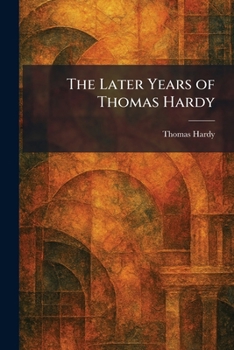
The Later Years of Thomas Hardy

"The Later Years of Thomas Hardy" provides a profound and detailed account of the final decades of one of the most influential figures in English literature. Serving as a continuation of his life story, this work covers the period from 1892 through to his death in 1928, a time marked by his definitive shift from prose to poetry.
This volume captures the atmosphere of Hardy's later life at his home, Max Gate, and explores his reactions to the critical reception of his final novels, most notably "Jude the Obscure". Readers are granted insight into the composition of his epic drama, "The Dynasts", and his numerous volumes of lyric poetry. The narrative blends personal observations with reflections on the literary circles of the era, offering a rare glimpse into the mind of a writer navigating the transition from the Victorian age to the modern era.
Rich with excerpts from diaries and letters, "The Later Years of Thomas Hardy" is an essential resource for understanding the man behind the masterpieces. It stands as a significant historical and literary document, preserving the legacy of a master stylist whose work continues to resonate with readers and scholars worldwide.
This work has been selected by scholars as being culturally important, and is part of the knowledge base of civilization as we know it. This work was reproduced from the original artifact, and remains as true to the original work as possible. Therefore, you may see the original copyright references, library stamps (as most of these works have been housed in our most important libraries around the world), and other notations in the work.
This work is in the public domain in the United States of America, and possibly other nations. Within the United States, you may freely copy and distribute this work, as no entity (individual or corporate) has a copyright on the body of the work.
As a reproduction of a historical artifact, this work may contain missing or blurred pages, poor pictures, errant marks, etc. Scholars believe, and we concur, that this work is important enough to be preserved, reproduced, and made generally available to the public. We appreciate your support of the preservation process, and thank you for being an important part of keeping this knowledge alive and relevant.
Customer Reviews
ThriftBooks ® and the ThriftBooks ® logo are registered trademarks of Thrift Books Global, LLC
