


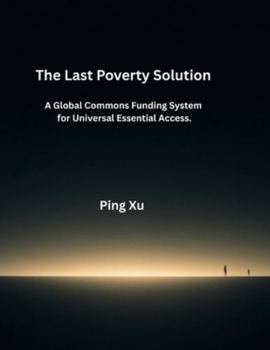
The Last Poverty Solution: A Global Commons Funding System for Universal Essential Access.

The Last Poverty Solution: A Global Commons Funding System for Universal Essential Access
What if the United Nations could finally escape its chronic financial crisis-without new taxes, without new treaties, and without touching state sovereignty?
This groundbreaking book presents the first fully feasible, politically neutral, and legally grounded architecture capable of giving the UN the stable resources it has lacked since 1945.
The Last Poverty Solution introduces a bold new system-
the Global Commons Sustainable Fund (GCSF) and
the Global Commons Value (GCV)-
a closed-loop humanitarian financing and access mechanism designed to solve the UN's mandate-resource gap once and for all.
The book argues a simple but transformative idea:
The world's crises have evolved, but the UN's financing model has not.
Instead of relying on voluntary donations that fluctuate with politics, the proposed system generates predictable resources from how humanity already uses shared global commons-aviation, maritime activity, digital networks, transboundary externalities, and more.
These contributions then convert into non-monetary humanitarian access rights-GCV units-that beneficiaries can redeem for essential goods and services such as food, water, shelter, health supplies, and energy.
No cash.
No currency.
No speculation.
No political controversy.
Only access.
The GCSF/GCV architecture is intentionally engineered to be:
Sovereignty-safe - no taxes, no national budget impact
Legally grounded - fully compliant with the UN Charter
Economically neutral - no inflation, no currency effects
Politically unblockable - no winners vs. losers, no redistribution
Operationally ready - uses existing UN digital tools, vendors, and oversight systems
This book shows how the UN can adopt the system immediately using only General Assembly authority-no Charter changes, no Security Council vote required.
What You'll LearnAcross 34 chapters, the book delivers:
A deep analysis of the UN's structural finance crisis
The legal foundation for usage-based global contributions
The economic logic behind non-monetary humanitarian quotas
The full operational model of GCSF → GCV → local vendor networks
Anti-corruption safeguards and digital traceability systems
Implementation pathways across sectors and countries
Case studies, scenario stress tests, and governance designs
A long-term vision for a UN that finally has predictable resources
Who This Book Is ForPolicymakers and diplomats
UN system professionals
International law and public finance scholars
Economists, humanitarian practitioners, and system designers
Anyone who believes global crises deserve stable global solutions
A Vision for a World With a Floor Beneath Every Human LifeThe Last Poverty Solution argues that poverty, crisis, and instability persist not because solutions are impossible, but because the global system lacks the architecture to deliver them predictably.
By redesigning how the world contributes to shared responsibility-and how the UN guarantees essential access-this book offers a practical, implementable path toward global stability, dignity, and resilience.
A new model for humanitarian financing is possible.
This is what it looks like.
Customer Reviews
ThriftBooks ® and the ThriftBooks ® logo are registered trademarks of Thrift Books Global, LLC
