


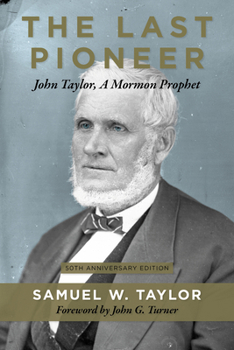
The Last Pioneer: John Taylor, A Mormon Prophet

Mormon prophet John Taylor's life is usually recounted as a series of anecdotes: singing hymns in Carthage Jail before a mob assassinated Joseph and Hyrum Smith, Taylor's life spared when, according to myth, his pocketwatch stopped a bullet; his practice of polygamy, including taking a wife fifty years his junior while on the run as a fugitive from federal marshals; and his 1886 revelation that said God would not "revoke" the law of plural marriage, "for it is everlasting," a revelation whose authenticity was questioned by the Church of Jesus Christ of Latter-day Saints for over a century but became the foundational text for breakaway sects continuing the practice of polygamy. But there was more to Taylor than his role in the martyrdom, his plural wives, his clashes with the federal government, and the legacy of fundamentalist Mormonism.
Taylor spent his first two decades in his home country of England before immigrating to Canada. His first wife, Leonora, was initially more interested when missionaries knocked on their door. But once he committed to the church, John Taylor was unflappable in his faith and zealous in his dedication. The Taylors moved from Toronto to Ohio, then to Missouri, and finally to Illinois as they followed their faith and their prophet Joseph Smith. John became an apostle in 1838 and a publisher thereafter, printing church newspapers. He followed Brigham Young to the Salt Lake Valley, where he became a prominent church and political leader for decades before finally ascending to the head of the faith in 1880.
In this timeless biography, Samuel W. Taylor weaves the threads of his grandfather's life into a rich tapestry. Drawing on letters, speeches, diaries, and reminiscences, a well-rounded and riveting portrait of the third Mormon prophet comes into focus. A professional writer by trade, Samuel Taylor was uniquely suited to tell this story--and what a story it is.
Customer Reviews
ThriftBooks ® and the ThriftBooks ® logo are registered trademarks of Thrift Books Global, LLC
