
Skip to content
Scan a barcode
Scan
Paperback The Last Paradise Book

ISBN: 1734955341

ISBN13: 9781734955347

The Last Paradise

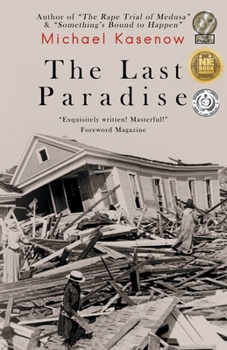
Galveston, Texas, where slaves were once auctioned. The Last Paradise follows the freed slaves and laborers through injustice and bigotry in post-Civil War America. The novel artfully weaves a tapestry of vivid and historic detail in this inspiring story of strength and survival. The alley people in Galveston band together against racism and poverty hidden within the hypocrisy of civic and corporate corruption. Men and women such as Fanny, Maxwell, Newt, Bishop, Elma, the nuns of St. Mary's, and the puckish poor who hang out at Bleach's Tavern journey through self-discovery to find their places in the changing landscape of a modernizing world. The alley people refuse to capitulate to the rich and privileged, drawing upon their strength and character, to be the free men and women demanded by their courageous spirits, even in the midst of turmoil.


Rich with stunning depictions of turn-of-the-century Galveston and the devastation wrought by the Great Hurricane of 1900, The Last Paradise illuminates resilience and fortitude of the great city itself, brought about by the same strengths held by its common citizens. Humorous, evocative, and sobering, this breathtaking novel is an adventure that encompasses the human soul.


"A must-read Poignant Breathtaking "

-Book Reviews


"Grand, sweeping panoramic novel "

-Best Sellers World


"Breathtaking Inspiring

A towering achievement "

-U.S. Review of Books


"Utterly fascinating read "

-Midwest Book Review


"A master... Great fiction "

-Reader Views

Recommended

Format: Paperback

Temporarily Unavailable

We receive fewer than 1 copy every 6 months.

Customer Reviews

5 ratings

A top pick for those looking for a good story about people

The Union's treatment of the former Confederacy was in no way saintly. "The Last Paradise" is a fictional tale focusing on post-Civil War Galveston, Texas. Focusing on the town as a whole several decades after the conflict, author Michael Kasenow draws a picture of a town trying to forge their way in the world. A tale of fighting upwards against societal and corporate pressures, "The Last Paradise" is an inspiring story and an utterly fascinating read. "The Last Paradise" is a top pick for those looking for a good story about people.

A fantastic book for lovers of historical fiction

Reviewed by Sandie Kirkland for RebeccasReads (4/09) In "The Last Paradise," Michael Kasenow takes the reader back to 1900 in Galveston, Texas. His narrative is different from most; instead of hearing Galveston's history from the rich and powerful, he shows it to us through the eyes of those who are poor and powerless. Ex-slaves, prostitutes, day laborers, card sharks and alcoholics, their day-to-day viewpoint of how the city worked is rare and fascinating. There are many interesting characters, but the book focuses on a man named Maxwell Hayes. Raised in a dysfunctional family, he broke away and has wandered the United States, drifting from job to job and leaving when situations arose that would tie him down. The defining time in his life was falling in love with a camp cook while he worked as a lumberjack. They were engaged when he came home to find that she had deserted him for another. This reinforced his inability to get close to other people. Maxwell has wound up in Galveston, where he works as a laborer at a shipping company, loading and unloading merchandise. All he asks of life is enough money to survive and a bottle of alcohol now and then. He spends time with others like him. There is Blair, a black man whose life story starts as a slave and who now has a son about to go to college. Newt Haskins is a former Yale man who left to make a living as a card dealer and gambler and who also works as a laborer. There is a mentally challenged couple that is protected by the others in the group. Maxwell is fond of a prostitute named Fanny and close to her son, Cody. There is a veterinarian who has lost his license and a fishing boat captain. They provide a support group for each other, and help other group members get through life issues. Things are about to change for Maxwell. One day Connor, the boss of the shipping company, comes to visit his empire, bringing his wife. Recognition is instant on both sides, as Connor's wife is Maxwell's first love. She wants to reinstate their relationship. As a complicating factor, her daughter Sara is also attracted to Maxwell. These issues and how these relationships play out fuel much of the book's narrative. Kasenow has obviously done a significant amount of research on Galveston's history. There are funny sections, such as the big shark-hunting contest entered by the group. The discrimination and difficulty of blacks in 1900 Texas is portrayed, along with the observation that one of the keys in ending racial discrimination was the lack of support by the big industrialists, who saw that Galveston was losing financial opportunities due to the way the rest of the country viewed the prejudice that existed there. One of the strongest parts of the book was the portrayal of the 1900 hurricane that killed thousands in Galveston. It is used to bring several plotlines together and to give resolution to the book. This book is recommended for lovers of historical fiction.

The Last Paradise

The Last Paradise is a step back into time. Times were harsh in Galveston, Texas just after the Civil War. Jobs were plenty but the promise of a better life was something that only those with money could afford to dream about. Some might say it was a simpler time but those people obviously never met Newt, Maxwell, Burley Horse (that's a woman), Bleach (the local tavern owner), Fanny (the local prostitute and apple of Maxwell's eye), Sara Connor (the boss' daughter), and Sister Ruby (a reformed former "working girl"). The story begins with a courtroom scene. Newt and Maxwell have been involved in a drunken brawl. With the help of Burley Horse, the two manage somewhat light sentences. Newt is sentenced to a year of sobriety, which he takes to mean only drinking when no one is looking. Both Newt and Maxwell are also given community service working with the nuns at a local orphanage. Immediately, the reader becomes part of the community. From the very start of this book, these people feel real with depth of character, pasts that might be better left in the past, and above all a sense of humor that gets them through some very difficult situations. On the surface, many of these individuals may not seem very loveable or even worthy of pity, yet as you get to know them it's very easy to feel an affinity to them.

Great historical fiction about Galveston, Texas

Reviewed by Richard R. Blake for Reader Views (3/09) Michael Kasenow resourcefully tracks the plight of the oppressed and exploited "alley people" of Galveston, Texas in the post Civil War era. "The Last Paradise" is a stirring story of the strength and endurance of these unwavering men and women fighting to keep their dignity through the trials of injustice and bigotry in the age of Jim Crow. In an environment where hypocrisy and corporate corruption are intent on spawning racism, prejudice, and poverty, Michael Kasenow weaves a powerful story of the courage, strength and survival of downtrodden men and their families. The alley people reflect an inner strength of character lacking in the affluent, town "bullies," the bigoted police officers, and the unscrupulous civic leaders in an atmosphere of political tension. The story moves forward with well-chosen words that begin at a lazy pace, casual, yet compelling - a nonchalance in keeping with the era and locale - Galveston in the early 1900s. Kasenow uses friendly moving banter among friends mixed with cutting barbs, sarcasm and prejudice to develop his characters. His descriptive word pictures draw the reader into his narrative as he describes the "crooked ambiance of Tin Can Alley" or how "the docks bustled with organized chaos." Vivid and detailed descriptions bring to life the architecture and commerce of downtown Galveston, the harbor, St. Mary's Orphanage, the salt marshes, and the wetlands. A master at character development, Kasenow's colorful cast include the regulars a Bleach's Bar, the "working girls" upstairs, Boss Conner and his wharf crew, the nuns and children at St. Mary's orphanage, Bishop and his family, Jenny and Sara Conner, Newt, and Maxwell and young Cody. Kasenow writes with such realism I felt the shame and humiliation of Bishop and his family as they were intimidated and harassed brutally before their friends by representatives of the law. In his account of the after effects of the Great Hurricane of 1900, Kasenow engaged the reader in all five senses: the stench of fear and death, the tenderness of touch in providing comfort, and the seeing of loved ones - thought dead. I felt the cooling water on a parched throat, heard the thrashing of hurricane force winds, and was left with the haunting memory of devastation left behind after the storm. "The Last Paradise" contrasts the emptiness of greed and the lust for power with the hopefulness and moral fiber of the alley people of the Galveston wharf. The novel is brutally forthright as it portrays an honest look at the brutality of evil men. On a lighter note Kasenow includes both rollicking and subtle humor and a thread of romance throughout the story. As in his poetic writings, Kasenow reveals the strength and triumph over despair, which produces healing through kindness with the reward of hope during harsh and chaotic times. "The Last Paradise" an editors choice book, is destined to establish Michael Kasenow as

A Great Read Although It Is Emotionally Trying!

Although Michael Kasenow's The Last Paradise was at times not easy to stay with as it dwells so profoundly upon appalling racist behavior, sadness and anger, all taking a heavy emotional toll, nevertheless it still was a great read. In addition, Kasenow's cast of rich and vivid characters particularly the two main protagonists and their stories make it possible for the reader to navigate a landscape that is at times appalling but nonetheless illuminating. In fact, you want to keep reading just to find out what becomes of them. Our tale unfolds in Galveston, Texas in 1900 just prior to the Great Hurricane when our two principal protagonists, Maxwell Hayes and his friend Newt Haskins are standing trial before a bigoted Judge Hammer. Apparently, the two were engaged in a knife fight while being smashed and were now standing trial for committing a public disturbance. Attorney Howard Dean is representing the accused, however, Judge Hammer shows very little respect for their legal counsel and he is ordered to sit down and keep quiet. Judge Hammer finds both guilty and as a punishment Newt is fined three dollars and is not to take a drink of alcohol for one year. He also must do community service three times at week at the St Mary's Orphanage. As for Maxwell, he is fined six dollars and this is probably the result of his getting on the good side of the judge telling him a story about his father who supposedly died at "Shilo. Fightin' for the Rebs." He even produces, as he professes, his father's authentic Confederate thirty-eight-caliber revolver with one gold bullet that belonged to a friend. Moreover, when asked by the bigoted judge why he liked Galveston, he replies that two signs attracted his attention when he entered the island six months ago. These signs told him everything he needed to know about Galveston. The first stated: "Welcome to Paradise, Galveston Texas, Wall Street of the Southwest Third Richest City in the Nation." The second, according to Hayes, was a real piece of work. One day, on his way back to his boarding house, he saw a dead African-American hanging from a noose on a tall oak tree with a sign around his neck: "screamin' like an angel: "This Nigger Voted." As we will find out, the implications of these two signs as well as Newt's community work and Maxwell's revolver with its one gold bullet all are eventually played out leading to an unforeseen ending. Kasenow has certainly done his homework in recreating the flavor of Galveston at the turn of the last century as he blends vivid and harsh descriptions with social, political and economic commentary that is caught up in a hideous and haunting tangle of racism. His knack in revealing off-the-wall characters in small gestures and poignant dialogue adds to their authenticity as we witness them being caught up in a range of situations, some not exactly lawful, that all come together into a tightly knitted story. He even manages to throw in a bit of romance and sly humor providin
Copyright © 2025 Thriftbooks.com Terms of Use | Privacy Policy | Do Not Sell/Share My Personal Information | Cookie Policy | Cookie Preferences | Accessibility Statement
ThriftBooks ® and the ThriftBooks ® logo are registered trademarks of Thrift Books Global, LLC

GoDaddy Verified and Secured