


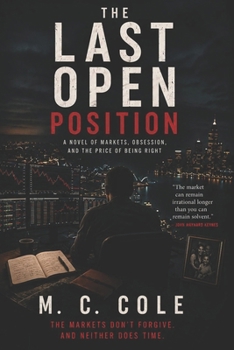
The Last Open Position

The market can remain irrational longer than you can remain solvent.
Daniel Carr spent thirty years believing he understood what that meant.
At eighteen, he inherited eight thousand dollars and opened his first trading account. Over the decades that followed, he navigated the dot-com crash, the commodities boom, the Global Financial Crisis, and the rise of cryptocurrency. He studied relentlessly. He kept journals. He built theories. More often than not, he was right.
The market rewarded him for it.
But this is not a story about money.
It is a story about Sophie, the woman who waited while another evening disappeared behind a closed study door.
It is a story about Liam, the son Daniel loved deeply and failed to notice slipping quietly into his own life.
It is a story about Marcus, the friend who remained long after there were reasons not to.
And it is the story of a man who spent decades measuring risk, while failing to see the losses accumulating everywhere else.
What Daniel loses is not taken from him in a single catastrophe. There is no dramatic collapse. No moment when everything changes.
Instead, there are postponed conversations. Missed evenings. Small silences that grow heavier with time.
The losses arrive the same way most lives are changed: gradually, then all at once.
Spanning more than three decades, The Last Open Position is a novel about obsession, ambition, marriage, friendship, and the dangerous belief that understanding a system is the same thing as understanding yourself.
For readers of Stoner, The Remains of the Day, and character-driven literary fiction, this is a quiet and devastating portrait of a man who could read markets with extraordinary clarity-and the people closest to him not at all.
Some losses can be calculated.
The ones that matter most rarely can.
Customer Reviews
ThriftBooks ® and the ThriftBooks ® logo are registered trademarks of Thrift Books Global, LLC
