


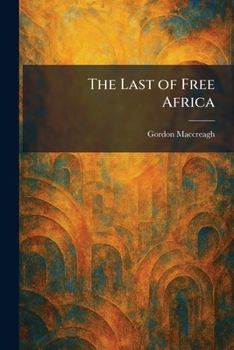
The Last of Free Africa

Select Format
Select Condition 
Book Overview
"The Last of Free Africa" is a compelling travel narrative and historical study that examines the unique status of Ethiopia as a sovereign nation during the height of European colonial expansion. Gordon MacCreagh provides a firsthand account of his travels through the highlands of Abyssinia, capturing the spirit and resilience of a kingdom determined to preserve its independence. The work offers a detailed look at the political landscape under the leadership of Ras Tafari, who would later become Emperor Haile Selassie, and explores the ancient customs and social dynamics that defined the region in the early 20th century.
Through vivid descriptions and sharp observations, MacCreagh highlights the cultural richness of the Ethiopian people and the geographic challenges of the landscape. The book serves as a vital record of African autonomy, documenting the complexities of maintaining freedom in a rapidly changing world. It remains a significant piece of exploration literature, providing valuable insights for readers interested in African history, anthropology, and the enduring legacy of one of the continent's most distinctive nations.
This work has been selected by scholars as being culturally important, and is part of the knowledge base of civilization as we know it. This work was reproduced from the original artifact, and remains as true to the original work as possible. Therefore, you may see the original copyright references, library stamps (as most of these works have been housed in our most important libraries around the world), and other notations in the work.
This work is in the public domain in the United States of America, and possibly other nations. Within the United States, you may freely copy and distribute this work, as no entity (individual or corporate) has a copyright on the body of the work.
As a reproduction of a historical artifact, this work may contain missing or blurred pages, poor pictures, errant marks, etc. Scholars believe, and we concur, that this work is important enough to be preserved, reproduced, and made generally available to the public. We appreciate your support of the preservation process, and thank you for being an important part of keeping this knowledge alive and relevant.
Customer Reviews
ThriftBooks ® and the ThriftBooks ® logo are registered trademarks of Thrift Books Global, LLC
