


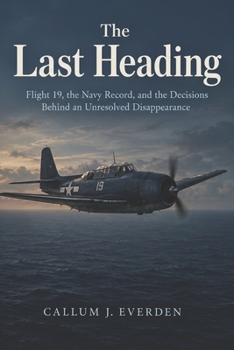
The Last Heading: Flight 19, the Navy Record, and the Decisions Behind an Unresolved Disappearance

Five Navy bombers disappeared in 1945. The mystery began before the silence.
On December 5, 1945, five U.S. Navy TBM Avenger torpedo bombers left Naval Air Station Fort Lauderdale on a routine navigation and bombing exercise. Fourteen men were aboard. The aircraft never returned, no confirmed wreckage from Flight 19 was recovered, and the disappearance became one of the most enduring mysteries in aviation history.
The Last Heading reconstructs the flight as an operational sequence rather than beginning with the later legend. It follows the route, radio traffic, reported compass trouble, conflicting position beliefs, changing headings, direction-finding evidence, worsening weather, and the steady loss of fuel endurance. At the center is a practical question: how did five functioning aircraft move from a recoverable navigation problem to a point from which no confirmed aircraft, crew member, or wreckage came back?
The book examines Lieutenant Charles C. Taylor's belief that the formation was near the Florida Keys against the route already flown, elapsed time, communications from other pilots, and later radio-direction findings that supported a position east of Florida. It traces the calls to fly west, the course changes that followed, the information available on the ground, and the narrowing window in which any correction still had to be heard, accepted, and acted upon before fuel became the controlling limit.
The reconstruction also separates Flight 19 from the loss of PBM-5 Mariner Training 49, the search aircraft that disappeared after being dispatched toward the missing Avengers. By treating the two losses as distinct evidentiary chains, the book examines what the surviving record can establish about each without turning proximity into proof of a shared cause.
The later investigation receives the same treatment. The Navy inquiry, the search effort, Katherine Taylor's challenge to the finding against her son, and the later administrative correction to "cause unknown" are examined for what they changed-and what they did not. Uncertainty about the final crash location is not treated as evidence that every explanation carries equal weight.
From there, the book follows the story's transformation into Bermuda Triangle mythology: the later grouping of unrelated disappearances, altered or expanded quotations, claims of radio silence, and the growth of cover-up narratives. Rather than dismissing institutional mistakes, it identifies missed information, fragmented communication, disputed decisions, and lost opportunities, then asks what additional evidence would actually be required to turn those failures into a documented concealment operation.
Written as a restrained historical aviation investigation, The Last Heading is for readers interested in Flight 19, U.S. naval aviation history, the Bermuda Triangle, unresolved disappearances, 1945 naval training, radio navigation, and the difference between an incomplete record and an extraordinary claim.
The final coordinates remain unknown. The sequence before them does not.
Related Subjects
HistoryCustomer Reviews
ThriftBooks ® and the ThriftBooks ® logo are registered trademarks of Thrift Books Global, LLC
