


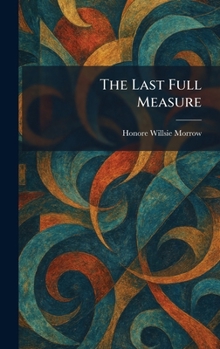
The Last Full Measure

"The Last Full Measure" is a moving and meticulously researched historical novel that concludes Honor Willsie Morrow's celebrated trilogy about the life of Abraham Lincoln. Set during the final, tumultuous years of the American Civil War, the narrative follows Lincoln as he grapples with the immense burden of leadership, the impending end of the conflict, and his vision for a reunited nation. Morrow provides an intimate portrait of the sixteenth president, balancing his public role as a statesman with his private struggles as a husband and father.
The story captures the atmosphere of Washington, D.C., in its most critical hour, detailing the political intrigues and the heavy emotional toll of the war. As the Union moves toward victory, the book explores themes of sacrifice, resilience, and the tragic circumstances leading toward the president's final days. Written with deep empathy and historical insight, "The Last Full Measure" offers a compelling look at one of America's most pivotal figures, emphasizing his enduring legacy and the profound devotion he gave to his country. This work remains a classic of early 20th-century biographical fiction, providing readers with a vivid window into the heart and mind of Lincoln during the nation's greatest trial.
This work has been selected by scholars as being culturally important, and is part of the knowledge base of civilization as we know it. This work was reproduced from the original artifact, and remains as true to the original work as possible. Therefore, you may see the original copyright references, library stamps (as most of these works have been housed in our most important libraries around the world), and other notations in the work.
This work is in the public domain in the United States of America, and possibly other nations. Within the United States, you may freely copy and distribute this work, as no entity (individual or corporate) has a copyright on the body of the work.
As a reproduction of a historical artifact, this work may contain missing or blurred pages, poor pictures, errant marks, etc. Scholars believe, and we concur, that this work is important enough to be preserved, reproduced, and made generally available to the public. We appreciate your support of the preservation process, and thank you for being an important part of keeping this knowledge alive and relevant.
Customer Reviews
ThriftBooks® and the ThriftBooks® logo are registered trademarks of Thrift Books Global, LLC
