
Skip to content
Scan a barcode
Scan
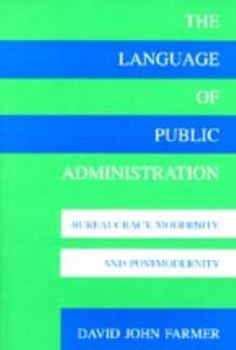
Paperback The Language of Public Administration: Bureaucracy, Modernity, and Postmodernity Book

ISBN: 0817307842

ISBN13: 9780817307844

The Language of Public Administration: Bureaucracy, Modernity, and Postmodernity

Coping with the practical problems of bureaucracy is hampered by the limited self-conception and the constricted mindsets of mainstream public administration thinking. Modernist public administration theory, although valuable and capable of producing ever more remarkable results, is limiting as an explanatory and catalytic force in resolving fundamental problems about the nature, size, scope, and functioning of public bureaucracy and in transforming public bureaucracy into a more positive force.

This original study specifies a reflexive language paradigm for public administration thinking and shows how a postmodern perspective permits a revolution in the character of thinking about public bureaucracy. The author considers imagination, deconstruction, deterritorialization, and alterity. Farmer's work emphasizes the need for an expansion in the character and scope of public administration's disciplinary concerns and shows clearly how the study and practice of public administration can be reinvigorated.

Recommended

Format: Paperback

Condition: Very Good

$13.69
Save $26.26!
List Price $39.95
Almost Gone, Only 1 Left!

Customer Reviews

1 rating

A Post-modernist Vision for Bureaucracy

"Early visitors to the moon did not expect to encounter entities such as a government, a budget, a paycheck, or a supervisor. Such public administration entities are not natural kinds; they are not givens" (p. 11), starts Farmer's book and captures interest of the reader immediately. This book presents an interesting comparative analysis of modern public administration with post-modern public administration that extends our horizons and makes us believe that something, we socially constructed, can be changed. Farmer uses reflexive interpretation as his method. Reflexive interpretation is concerned with why we see (understand) what we are seeing (understanding) and with the possibilities for seeing (understanding) something differently by changing the lens (p. 13). That is, the leading concern is why we are seeing what we are seeing and whether we could see it differently; it is reflexive interpretation. Farmer pulls us to the enjoyable point at which we can relentlessly question our basic assumptions regarding reality of public administration so that we can be aware and change our socially constructed realities. The book is grouped into mainly two parts, modernity and post-modernity. In modernity part, Farmer examines modern public administration's limits: limits of "Particularism", "Scientism", "Technologism", "Enterprise" and "Hermeneutics". In post-modernity part, as solutions to the limits of modern public administration, Farmer examines post-modernist concepts "Imagination", "Deconstruction", "Deterritorialization" and "Alterity". Particularism, according to Farmer, creates blind spots that prevent us from seeing alternative ways of doing things. Based on "American" "Public" "Administration" he debunks particularism's paralyzing impact. "American" emphasis impedes looking at different societies to transfer some innovations; "Public" emphasis prevents public and business sectors from learning from each other and neglects the interrelationships between two sectors; "Administration" emphasis (based on functional and programmatic POSDCORB) creates competing paradigms that emphasize functions and programs more than their content and action. "Scientism" (think about fact-value dichotomy) gives no space for ethics in public administration (because ethical values are not open to hard positive measurement), and so "administrative ethics suffers from the difficulty of identifying a moral grip for core values" (p. 85). Viewing public administration as "technology" (applied vs. episteme) suggests recognizing that practitioners should assume more ownership for public administration theory (p. 91). However, as Farmer points out, such a viewing makes it impossible to integrate systems and management and ethical considerations. Seeing public administration from an "enterprise" (entrepreneurial) window, without the system of capitalist rationalization (missing in public service), according to Farmer, is doomed to failure. "Imagination", a softly "oxymnoron"
Copyright © 2026 Thriftbooks.com Terms of Use | Privacy Policy | Do Not Sell/Share My Personal Information | Cookie Policy | Cookie Preferences | Accessibility Statement
ThriftBooks® and the ThriftBooks® logo are registered trademarks of Thrift Books Global, LLC

GoDaddy Verified and Secured