


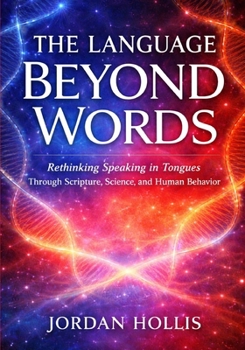
The Language Beyond Words: Rethinking Speaking in Tongues Through Scripture, Science, and Human Behavior

What if speaking in tongues is not what you have been told?
In The Language Beyond Words, Jordan Hollis presents a rigorous, interdisciplinary investigation into one of the most misunderstood phenomena in religious and human experience. Moving beyond doctrine, assumption, and institutional framing, this book examines glossolalia through the combined lenses of biblical scholarship, psychology, neuroscience, anthropology, and emerging fields such as biophysics and epigenetics.
Across cultures and centuries, human beings have independently produced the same form of non-semantic vocalization in states of profound interior intensity. This book asks a simple but overlooked question: what is this phenomenon at its core, before it is interpreted, controlled, or explained?
Beginning with the anthropological record, Hollis demonstrates that speaking in tongues is not confined to Christianity, but appears as a consistent human behavior across civilizations. From there, the book offers a careful and contextually grounded reading of the biblical texts, distinguishing between what the earliest writers described and what later traditions constructed around it.
The investigation then moves inward, exploring what happens in the brain and body during authentic glossolalia. Drawing on neuroimaging research and the science of sound, the book examines how vocalization interacts with the nervous system and the possibility that this phenomenon operates at a deeper biological level than previously understood.
Finally, The Language Beyond Words turns to lived experience. It explores the conditions under which authentic expression arises, the psychological barriers that inhibit it, and the consistent testimony of individuals across traditions who describe encountering something beyond ordinary language and cognition.
This is not a theological argument, nor a dismissal of faith. It is an evidence-based inquiry into a human capacity that has been widely practiced, widely misunderstood, and rarely examined on its own terms.
For readers willing to follow the evidence across disciplines, this book offers a clear and uncompromising answer to a question that has been obscured for generations.
Customer Reviews
ThriftBooks ® and the ThriftBooks ® logo are registered trademarks of Thrift Books Global, LLC
