


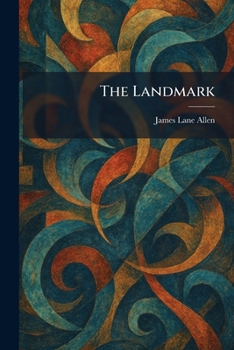
The Landmark

Select Format
Select Condition 
Book Overview
"The Landmark" is a poignant and evocative collection of short stories by the acclaimed American author James Lane Allen. As the final volume completed by the author, this work serves as a testament to his mastery of lyrical prose and his deep sensitivity toward the human condition. The collection includes the titular story, "The Landmark," alongside other compelling narratives such as "The Ash-Can," "The Violet," and "Miss Locke," each exploring the intricacies of character and the subtle shifts of emotion that define the experience of life.
Set often against the backdrop of the American South and the Kentucky landscape Allen knew so intimately, these stories weave together themes of memory, the passage of time, and the spiritual connection between individuals and their surroundings. Allen's writing is characterized by its psychological depth and its focus on the moral and social dilemmas of his time. "The Landmark" offers readers a refined example of early 20th-century American realism, capturing quiet, profound moments with a grace that remains timeless. This collection is an essential read for those interested in the evolution of the short story and the enduring legacy of one of Kentucky's most celebrated literary figures.
This work has been selected by scholars as being culturally important, and is part of the knowledge base of civilization as we know it. This work was reproduced from the original artifact, and remains as true to the original work as possible. Therefore, you may see the original copyright references, library stamps (as most of these works have been housed in our most important libraries around the world), and other notations in the work.
This work is in the public domain in the United States of America, and possibly other nations. Within the United States, you may freely copy and distribute this work, as no entity (individual or corporate) has a copyright on the body of the work.
As a reproduction of a historical artifact, this work may contain missing or blurred pages, poor pictures, errant marks, etc. Scholars believe, and we concur, that this work is important enough to be preserved, reproduced, and made generally available to the public. We appreciate your support of the preservation process, and thank you for being an important part of keeping this knowledge alive and relevant.
Customer Reviews
ThriftBooks ® and the ThriftBooks ® logo are registered trademarks of Thrift Books Global, LLC
