


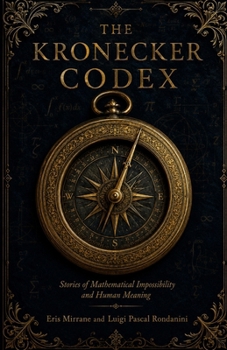
The Kronecker Codex: Stories of Mathematical Impossibility and Human Meaning

In 1900, the mathematician David Hilbert presented twenty-three problems that would shape a century of inquiry. Some have been solved. Others have been proven unsolvable. A few remain stubbornly, provocatively open.
The Kronecker Codex reimagines those problems as the impossible questions that govern human experience: What happens when love refuses logical consistency? When grief introduces breaks that cannot be smoothed away? When identity occupies spaces that resist classification?
Twenty-three stories follow the Kronecker family across generations and continents. Vera escapes a cult and discovers the uncountable space between salvation and damnation. Lucien, a pure mathematician, falls for an artist whose contradictions expose the limits of formal logic. Rosa uncovers her grandmother's journals, written in a language of transcendental emotion that resists rational translation. Carlos, an immigration lawyer, represents cases the legal system cannot decide. Quinn, a fashion designer with vitiligo, discovers that human beauty operates by the same principles as uniformization theory. And Zephyr, the ageing patriarch, gathers the family for a reckoning with the mathematics of meaning itself.
Linked by a brass compass said to have belonged to Leopold Kronecker - an instrument that points not toward solutions but toward the questions worth asking - these stories form a cycle that rewards both independent reading and cumulative engagement. Together, they argue that the most important truths are those that emerge not from solving impossible problems but from the quality of attention we bring to them.
The Kronecker Codex is a book for readers who love literary fiction that takes ideas seriously - and for anyone who suspects that the questions we live with may be more important than the answers we find.
Customer Reviews
ThriftBooks ® and the ThriftBooks ® logo are registered trademarks of Thrift Books Global, LLC
