


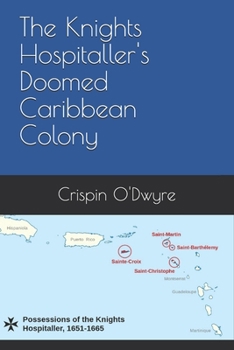
The Knights Hospitaller's Doomed Caribbean Colony

In 1651, one of Europe's most prestigious medieval institutions purchased Caribbean islands and embarked on an extraordinary colonial experiment that would challenge everything they believed about governance, morality, and their sacred mission. For fourteen remarkable years, the Knights Hospitaller-warrior-monks who had defended Christendom for five centuries-ruled Saint Christopher, Saint Croix, Saint Barth lemy, and Saint Martin with spectacular ambition and tragic contradictions.
This meticulously researched narrative reveals how Philippe de Poincy, a charismatic French knight, transformed humble Caribbean settlements into a glittering tropical court that rivaled European palaces. Through diplomatic brilliance and creative governance, he expanded Hospitaller control across multiple islands while navigating complex relationships with Dutch, Spanish, and English colonial powers. Yet beneath the impressive architecture and ceremonial splendor lay fundamental contradictions that would doom the enterprise.
The Knights' humanitarian ideals collided with the brutal realities of plantation slavery. Their medieval institutional structures proved inadequate for governing across Atlantic distances. Most critically, their creative colonial experiment occurred precisely when European powers were consolidating direct state control over overseas territories, making their proprietary model obsolete.
This forgotten chapter of colonial history illuminates the transition from entrepreneurial to systematic colonialism while exploring timeless questions about institutional adaptation, moral compromise, and the clash between traditional values and modern pressures.
Related Subjects
HistoryCustomer Reviews
ThriftBooks ® and the ThriftBooks ® logo are registered trademarks of Thrift Books Global, LLC
