


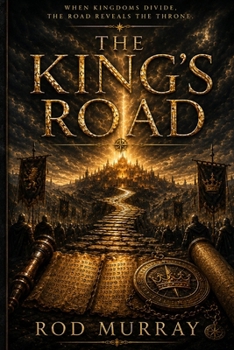
The King's Road

The world has received its bill.
Across nations, impossible words begin rising from stone.
They appear in public squares, across dam walls, on prison walls, in forests, fields, temples, and places governments believed history had safely buried.
No army delivers them. No government controls them. No human hand writes them.
They are called the Receipts.
And everywhere they ask the same terrible question:
WHAT DID YOU BUILD WITH THE BORROWED EARTH?
Sarah Keller has learned that truth rarely arrives in the form people expect-and that institutions become most dangerous when they discover how to manage what they cannot deny.
Now the reckoning has moved beyond archives and warnings.
Buried graves emerge beneath a nation's ceremonial square. A river confronts those who turned thirst into profit. A prison begins naming the forgotten. Forests remember what was taken from them. Children erased by statistics return to the ledger.
But naming the debt is only the beginning.
Sarah Keller, Eli Navarro, Jonas Vale, and former minister Regev now face the harder question:
What does repair actually require?
Jonas Vale understands leverage, risk, ownership, and the price of almost anything. He also recognizes what others do not: once governments and markets accept the Receipts as real, powerful people will try to turn accountability itself into a commodity.
Soon the machinery begins.
Restoration authorities. Certification systems. Institutional exemptions. Global compacts. Tradable restoration credits.
The old world does not simply resist the truth.
It learns how to profit from it.
Jonas must decide whether his knowledge of the machine will preserve it-or expose it.
For Regev, there is nowhere left to hide.
Once a powerful minister, he spent decades in a world where signatures become policy, policy becomes consequence, and consequence disappears beneath words such as necessity, security, and national interest.
Now the Receipts are opening the files.
And some of the signatures are his.
Stripped of office and authority, Regev must confront the difference between accepting institutional responsibility and saying the far more difficult words:
I did this.
Sarah faces another danger. Truth itself can become power. As governments, activists, corporations, victims, and opportunists struggle to control the Receipts, she must guard against becoming what she has opposed: another person claiming the right to control the truth.
Then something extraordinary begins.
Where graves are named, water is returned, prisoners are heard, children are protected, and restitution becomes service rather than spectacle, fragments of a road begin to appear.
Not a road built by armies.
Not a road owned by governments.
Not a road purchased by wealth.
The King's Road.
Humanity expected judgment to arrive as destruction.
Instead, it arrives as responsibility.
There will be no convenient apocalypse to erase the books. The world remains-and with it the wounded, the guilty, the innocent, and the terrible work of repairing what can still be repaired.
Beyond it all, the Mountain waits.
And somewhere beyond the Mountain, the King is drawing nearer.
THE KING'S ROAD continues the journey begun in THE SCROLLS OF THE WATCHMAN and THE MYSTERY MOUNTAIN-a sweeping speculative novel of mystery, moral reckoning, institutional power, restitution, and mercy.
The question is no longer whether humanity is guilty.
The question is what humanity will do now that it knows.
Customer Reviews
ThriftBooks ® and the ThriftBooks ® logo are registered trademarks of Thrift Books Global, LLC
