


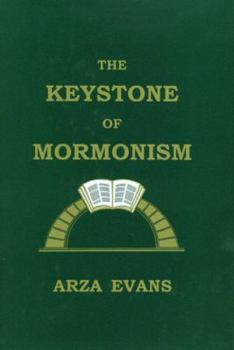
Keystone of Mormonism

Select Format
Select Condition 
Book Overview
The Keystone of Mormonism is one of the most powerful books ever written exposing the differences between Mormonism and traditional Christianity. It presents excellent reasoning and scientific... This description may be from another edition of this product.
Format:Hardcover
Language:English
ISBN:0972881301
ISBN13:9780972881302
Release Date:January 2003
Publisher:Keystone Books Inc
Length:332 Pages
Weight:1.96 lbs.
Dimensions:10.3" x 1.0" x 7.3"
Customer Reviews
5 ratings
In response to Bobby Boylon
Published by Thriftbooks.com User , 18 years ago
BB: In 1994, for example, Warren and Michaela Aston published the book, "In the footsteps of Lehi," revealing that plausible candidates for both Nahom (1 Nephi 16:34) and Bountiful exists in the Arabian Peninsula. JK: Nahom & Bountiful? Sorry dude we don't want plausable candidates, we want definite confirmation! BB: Furthermore, only a few years later, George Potter discovered a continaully flowing river in Arabia, right where the Book of Mormon states it is. This was one of the first topics discussed in the 2003 book he co-authored with Richard Wellington, entitled, "Lehi in the Wilderness." JK: I Nephi 2:5-8 says that the River Laman emptied into the Red Sea. But, there are no rivers in all of Arabia now or in recorded history, and no river empties into the Red Sea! The Red Sea is a body of water connected to the Mediterranean Sea on the north and to the Indian Ocean on the south. When it rains, which is rare, a wadi (a dry riverbed) will carry water for a short time. But a wadi is not a river. BB: Now, the questions of Evans can be turned on their back - How did Joseph Smith know so much about Arabia? JK: The guy could read, books on geography and cultures wouldn't have been too far out of his reach. BB: How did he know of the presence of a continually flowing river south-south-east of Jerusalem in Arabia, when, for decades, critics have derided such (and, in their ignorance, continue to do) as an impossibility (see 1 Nephi 2:5-8)? JK: A wadi is not a river (read my comment above). BB: How did he know of a burial site, *NHM* in the same direction, corresponding to "Nahom" where Ishamel was buried in 1 Nephi 16:34? JK: It is important to note that NHM is believed to be a tribal name, not a place name, and that the three consonants can have a variety of spellings when vowels are inserted. Aston notes in his web site article that references to NHM are "usually given as NiHM, NeHeM, NaHaM etc." The Journal of Book of Mormon Studies reports that this can also be spelled "NaHM" (7:1, 1998, p. 7). BB: In addition, how could Smith have known of a lush garden spot east of Nahom, and describe all its physical and material cultural characteristics, when, again, critics have derided Bountiful in Arabia as another impossibility? JK: Let's not forget that Bountiful's temporary filler is only a candidate. And NHM doesn't mean NaHoM. Subsequently, this lush garden spot east of NHM maybe cactus plants.
Great book - great read
Published by Thriftbooks.com User , 19 years ago
It is a quick and easy book to read. It covers many aspects of the belief system and identifies the source documents where the original information can be found. It does not go into the scholarly information in the way Quinn or Brodie would address the subjects, but provides an overview of some of the major problems found in the Mormon Church. The author goes beyond most books of this type and explores the sociological and control aspects of the Mormon Church. He shows how the Mormon Church manipulates and controls its members using many of the same techniques as the founders. He also discusses the egocentric nature of the early leaders and ethnocentric beliefs found in the Mormon Church. He demonstrates the level of lying and hiding the truth which was prevalent in the early Mormon Church. This lying and hiding the truth about the history and doctrine is still a common characteristic in the Mormon Church. Criticism has been given in light of the "Trail of Lehi" and "In the Footsteps of Lehi." The "Trail/Footsteps of Lehi" book, lectures and tours have been discredited by the Mormon Church's own apologists, the FARMS organization. This includes the river, alters, names, locations and other information included in the book.
Engaging -- tough to put down
Published by Thriftbooks.com User , 21 years ago
Arza's is yet another story of a faithful lifetime member of the Church of Jesus Christ of Latter-day Saints (LDS or Mormon) who decides to investigate the claims of the Book of Mormon and research church history only to discover all sorts of problems, inconsistencies, and deception. And, like others, Arza went on to write a book about what he found and ended up getting excommunicated. Such is the all-to-common fate of intelligent and honest members of the church who look too deeply at the shadowy history of Mormonism. "The Keystone of Mormonism" is ostensibly a book about the Book of Mormon, which was written by the church's founder, Joseph Smith, and is presented by the church as literal scriptural history of ancient America. Arza's taken the title of his book from a comment by Joseph Smith (founder of the Mormon Church) to the effect that the Book of Mormon is ".... The most correct of any book on earth, and the keystone of our religion..." While the first part of Arza's book is about the Book of Mormon, and its many well-known and serious problems with science, the second half is a treatise on LDS doctrine and some of the darker episodes in LDS history. Woven throughout Arza's book is his clear and unmistakable conclusion that Smith was a con artist, adulterer, and a shrewd and calculating cult leader devoid of common standards of morality and decency. This, of course, is the polar opposite of how Mormons view their leader. The difference being largely due to the way in which Mormons are raised on a diet of official historical fiction/fantasy, while Arza's conclusions are drawn from his extensive examination of historical documents and even-handed application of standards for moral decency. For devout Mormons, Arza's book will hardly be convincing. It's simply too easy for true believers to glibly ignore critical information about the church while claiming the apostates are possessed of a "lying tongue," and given over to the devil. What these members would see, if they'd bother looking, is that virtually all of Arza's conclusions are drawn from pronouncements made by church leaders, who were speaking in their capacity as "prophets, seers, and revelators" while publishing their teachings using church avenues of communication. For example, one of Arza's points is that Smith was full of himself, and that he organized the church, in part, to feed an insatiable ego. To back this up, Arza quotes dozens of passages from church documents that illustrate how egotistical Smith really was. Here is an example from the Doctrine and Covenant (official LDS scripture): "Whatsoever they [Smith and other priesthood leaders in the church] shall speak when moved upon by the Holy Ghost shall be scripture, shall be the will of the Lord, shall be the mind of the Lord, shall be the word of the Lord, shall be the voice of the Lord, and the power of God unto salvation." Mormons often quote this scripture to justify strict obedience to their c
The most important new analysis of The Book of Mormon
Published by Thriftbooks.com User , 21 years ago
I loved reading this book. I started on a Saturday morning and could not put it down. I was locked in, and read it straight through over a weekend. As a lifetime active member of the LDS Church, this book moved me deeply to my very core in every way: emotionally, intellectually and spiritually. I learned more about the Book of Mormon and Church history from Professor Evans than I had anywhere else before. This book is a treasure chest of essential information from official LDS Church sources for anyone who takes study of the Book of Mormon seriously.Evans' many years of impeccable research for this book is very evident in his unwaveringly honest and well organized approach. His sources are verbatim quotations from official LDS Church publications so they are unimpeachable. As a result, The Keystone of Mormonism is one of the most important analysis of the Book of Mormon and relevant LDS history written to date. It is highly recommended for the both the LDS reader and those interested in understanding the history of Mormonism. The author is a lifetime member of the LDS church, a former missionary, church leader, and former college professor. Evans' teaching expertise is evident in his writing. His personal style will engage the average reader, yet all his references are meticulously footnoted in the back of the book to satisfy the interests of the most ardent scholar.The Keystone of Mormonism is a highly factual historical analysis of official LDS records but it is far from a dry historical read. What makes these facts so spellbinding and valuable to the reader is that Evans relates his historical discoveries in a voice that reveals his most personal inner reactions on his unfolding journey of discovery into official Church documented history. Ultimately his research reveals much more that is unsettling about Mormonism than he had counted on discovering and the challenge it presents to Evans faith will be echoed in the heart of every honest LDS reader.
WOW!
Published by Thriftbooks.com User , 22 years ago
As a Utah physician, raised in and around Mormonism my entire life, I had a hard time putting this one down. I have given out multiple copies of this book over the last week! The Keystone of Mormonism is an excellent reference work for those wanting a well researched, well written book on the Book of Mormon and early Mormon leaders and 'prophets'. This author does a great job not only exposing the truth as well as documenting his statements. Particularly moving are his struggles through disillusionment, psychological pain, and disappointment. A must read and sure to be talked about for years to come!
Copyright © 2026 Thriftbooks.com Terms of Use
| Privacy Policy | Do Not
Sell/Share My Personal Information | Cookie Policy | Cookie Preferences | Accessibility Statement
ThriftBooks® and the ThriftBooks® logo are registered trademarks of Thrift Books Global, LLC
ThriftBooks® and the ThriftBooks® logo are registered trademarks of Thrift Books Global, LLC
