


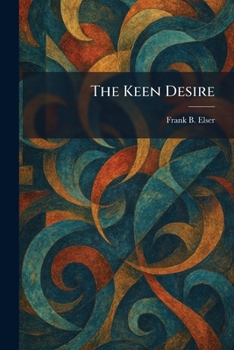
The Keen Desire

"The Keen Desire" is a poignant exploration of youthful ambition and the restless search for authenticity in early 20th-century America. Written by Frank B. Elser, this compelling novel follows the journey of Martin Lavery, a talented but disillusioned young newspaper reporter working in a provincial Southern town. Trapped between his intellectual aspirations and the stifling social mores of his environment, Martin grapples with a profound sense of dissatisfaction that he labels his "keen desire."
The narrative captures the vibrant yet demanding world of journalism, charting Martin's evolution from a cynical observer of small-town hypocrisy to an ambitious seeker in the bustling metropolis of New York City. Through sharp prose and keen psychological insight, Elser examines themes of social climbing, the challenges of creative integrity, and the often-painful transition into adulthood. As Martin navigates complex romantic entanglements and professional setbacks, the work serves as a timeless reflection on the struggle to reconcile one's inner ideals with the harsh realities of the modern world. "The Keen Desire" stands as a significant contribution to the literature of the 1920s, offering a vivid portrait of a generation caught between tradition and the allure of the unknown.
This work has been selected by scholars as being culturally important, and is part of the knowledge base of civilization as we know it. This work was reproduced from the original artifact, and remains as true to the original work as possible. Therefore, you may see the original copyright references, library stamps (as most of these works have been housed in our most important libraries around the world), and other notations in the work.
This work is in the public domain in the United States of America, and possibly other nations. Within the United States, you may freely copy and distribute this work, as no entity (individual or corporate) has a copyright on the body of the work.
As a reproduction of a historical artifact, this work may contain missing or blurred pages, poor pictures, errant marks, etc. Scholars believe, and we concur, that this work is important enough to be preserved, reproduced, and made generally available to the public. We appreciate your support of the preservation process, and thank you for being an important part of keeping this knowledge alive and relevant.
Customer Reviews
ThriftBooks ® and the ThriftBooks ® logo are registered trademarks of Thrift Books Global, LLC
