


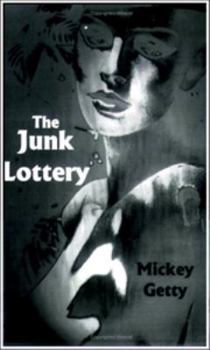
The Junk Lottery

After her husband's death from a self-inflicted gunshot wound, Alma sorts through Mack's junk in the basement, uncovering, as she does so, not just the memories of what was but also what could have... This description may be from another edition of this product.
Format:Paperback
Language:English
ISBN:0988242001
ISBN13:9780988242005
Release Date:September 2012
Publisher:Mickey Getty
Length:300 Pages
Weight:0.65 lbs.
Dimensions:9.0" x 0.7" x 6.0"
Customer Reviews
4 ratings
great book to curl up with
Published by Thriftbooks.com User , 18 years ago
loved reading this book... the story kept me interested to the end... found myself getting involved with the story line...
A warm and compelling story of self-discovery
Published by Thriftbooks.com User , 19 years ago
Mickey Getty's The Junk Lottery is the warm and compelling story of the belated coming-of-age of Alma McCallum. It is rare to see a woman like Alma, in her fifties, a mother and grandmother, as a central character in a novel; generally the stories of such women, as Alma herself realizes, are presumed to be over. Their lives are what they are. But Ms. Getty turns that notion on its head, and shows us that there is plenty that remains to be told in the story of a woman's life. A recent widow at the beginning of the novel, Alma is still trying to cope with her husband Mack's suicide the way she has always coped with difficulties in her life: by telling herself how lucky she is and choosing to remember only the good times she and Mack had together. Nonetheless, she avoids the basement, where she discovered his body amid the piles of junk he had salvaged over the years. Alma's initial descent into the basement is the beginning of a summer of self-discovery, wherein she learns to face the truth about her life with Mack, and about herself. Each discovery peels back another layer of self-deception, starting with the thousands of dollars Mack stashed in the basement, money that could have been spent to give their children shoes and medical care. Mack was not just thrifty, Alma realizes, he was borderline-sadistic, risking not only her life, but the lives of their children. But she must also face that she was an accomplice, refusing to intervene even when his rages drove their teenage daughter Grace to run away and all but sever contact with her family. And she must face the consequences of denying her own sensuality, burying her own needs beneath the mask of "Saint Alma the Pure," the perfect wife and mother. But there are happier discoveries in The Junk Lottery, too, like the joys of solitude after a night out: "She sat down and ate her mushroom, bacon, cheese omelet, hot and fresh. No interruptions. Hot food. A unique experience for Alma. She hadn't appreciated her hot meals since Mack died, or even noticed. She ate slowly and savored every bite. Sipped her orange spice tea in the quiet of her kitchen. Alone I haven't noticed how good alone feels, she thought." There is also Tony Sullivan, the handsome new architect in town, who shows Alma the possibilities of her new life alone, things she hadn't even begun to imagine. The Junk Lottery is populated by a cast of engaging characters, most notably Alma's best friend Petra, independent and blunt and affectionate; George Herlihy, Alma's old friend and self-appointed protector; Grace, bristling with resentment but still desperate for her mother's affection; and Nature itself, which Ms. Getty renders in loving detail. But Alma herself is the centerpiece of the novel, alternately brave and cowardly, assertive and meek, a woman in search of her own voice, and it is a credit to Ms. Getty that, after following her through her darkest moments, we, too, feel we have emerged int
Junk from the past.....
Published by Thriftbooks.com User , 19 years ago
Mickey Getty's novel, The Junk Lottery, reviewed by Florida writer, Diane Duritt, author of In Confidence. Mickey Getty's novel The Junk Lottery isn't about junk. Getty leads the reader into the inner world of Alma McCallum, a widow who is left with the daunting task of cleaning out the basement. It's filled with odds and ends, tools and broken furniture that, Mack, her deceased husband collected over the years. The only clear area sits at the base of the newly painted wall, serving to conceal Mack's violent death. Flashbacks of that scene keep Alma away from the cellar stairs. Her life long friend, Petra, helps Alma take that first step down. She had avoided the task much too long. Petra has always been there for Alma and now is no exception. They sort through Mack's artifacts and find that Alma's future will be driven by the unexpected. Unbeknownst to Alma, Petra kept in touch with Alma's estranged daughter, Grace. When Grace returns home after eight years of absence, a failed marriage and children in tow, friction runs high between she and her mother. Alma turns on Petra, resenting the close connection Petra has with Grace. Strained relationships leave Alma to face her own personal imperfections, as Petra and Grace look on. Mickey Getty's novel isn't about Alma, the widow who suffers from the trauma of her husband's death. It's about the deep connections between women. The men in the novel are shaped into faithful friends, new lovers, a son and brother, and Grace's ex-husband-to-be. The reader meets them through Alma's thoughts and Getty's prose. Alma's deceased husband, Grace's father, Mack, is as alive as any of the characters in the novel. Grace's contempt for her father overflows into anger with Alma. Grace confronts Alma about her role in allowing Mack to isolate them, depriving Grace, and her brother and sister, of the life they could have had. When Alma tells Grace that she found a substantial amount of money hidden in the basement, Grace's resentment explodes. Alma is forced to come to terms with all three of her adult children. Alma succeeds in cleaning the basement, literally, and begins to put her external world in order. She may need more time to come to terms with her inner feelings. The book closes with the sense that Alma is able to accept the responsibility for making her life what it was and what it will be in the future. Much like the work of Anne Tyler, Getty creates her characters from the inside out, molding them in such a way that the reader feels a connection and an intrinsic tug in identifying with Alma`s thoughts and feelings. The author's prose stirs the reader as Alma moves toward self-acceptance. Getty has written a literary page turner. You won't want to put The Junk Lottery down until the last page is turned. Diane Duritt, author of In Confidence.
Growing up at any age
Published by Thriftbooks.com User , 19 years ago
In the tradition of Joyce Carol Oates and Anne Tyler, Getty is a new voice speaking in defense of the feminism we first propounded three decades ago, and which threatens to be eroded with each new generation. Nonetheless, Junk Lottery has no political agenda. It is, quite simply, a rousing good story with chickens and chain saws, bears and blood, and all manner of seduction. Mack McCallum is the miser who launches the story. He has been dead one year, having killed himself with his shotgun when his cancer became too advanced--or perhaps too expensive. He has loved his wife and family as best he could, and his wife has made the best of it, finding her luxury in her sense of smell, and sight, and touch, those things that no one can keep from us. As a young girl with a guilty past, Alma marries Mack with equal parts love and the sense that Mac is all she deserves. Though close to all the conveniences of a modern city, they live in the shack that Mack slowly builds into a cabin around them. There she gives birth to her first child under savage circumstances that evoke the image of frontier life. Alma participates in Mack's miserliness by keeping his house and raising his children under his tightfisted control while he spends his free time scavenging junk yards. Alma's story is told amidst the natural abundance of a northeastern countryside, portrayed delectably by Getty, who turns the sight of a forest clearing or the smell of making muffins into a poem. Her lyrical yet lean style forms a counter-point to the harsh realities of her existence, and provides a motif of the character's capacity for joy. Ultimately, The Junk Lottery is a coming of age story, one that presents marriage as a possible obstacle to growth. The story asks what, often, we as wives give up of ourselves by "making the best" of our relationships. Alma is forced to realize she's been hoarding her love. When she discovers in the basement exactly what Mack had withheld from her and her children, she begins the process of getting herself back again, going on, and finally growing up.
Copyright © 2026 Thriftbooks.com Terms of Use
| Privacy Policy | Do Not
Sell/Share My Personal Information | Cookie Policy | Cookie Preferences | Accessibility Statement
ThriftBooks® and the ThriftBooks® logo are registered trademarks of Thrift Books Global, LLC
ThriftBooks® and the ThriftBooks® logo are registered trademarks of Thrift Books Global, LLC
