


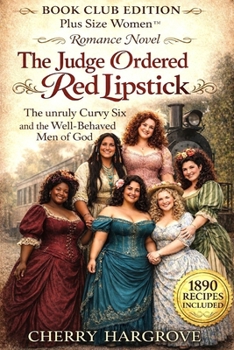
The Judge Ordered Red Lipstick: the unruly curvy six and the well-behaved men of God

Six men board a westbound train believing holiness requires distance.
They are the Covenant Six-handsome, disciplined builders in black coats, headed to the frontier with a spotless plan: land, doctrine, control, and "proper" wives chosen by a mission board.
Then the other six women step into first class... laughing.
They are wealthy, diverse, unmistakably curvy, and unashamed-women who give away food and coats like it's normal, who invite the poor into fellowship, who talk business and land like they were born holding deeds in one hand and Scripture in the other. And when the Covenant Six try to shame them into silence?
The women answer with a scandalous kind of righteousness:
joy.
On that train, "order" turns into obsession, "correction" turns into comedy, and lipstick becomes a declaration. One blown kiss becomes six. One hymn becomes a showdown. And when the men decide they've had enough, they do what they've always done-appeal to authority.
They file a formal complaint.
They demand a judge.
So the train stops in Briar Ridge, and Circuit Judge Silas Hardwick hears the case-while Sheriff Amos Crowell watches the whole town lean in for the outcome. The men want the women punished and pushed down to second class "for Christian witness."
But the judge sees what no one wants to admit out loud:
These twelve people are not fighting over decency.
They're fighting over control versus love.
In a courtroom that feels more like a reckoning than a hearing, truth finally comes up from the floorboards: the men have fallen, the women have fallen-and neither side can pretend anymore.
And then comes the ruling no one saw coming...
The judge orders the marriages.
Not as a humiliation-but as a correction of the heart.
And when the couples are joined, the women add one final condition to the covenant-bold enough to make the courtroom laugh and holy enough to make it stick:
Red lipstick... for the length of the marriage.
What follows is tender, funny, and deeply satisfying: new rings bought in town, new boundaries learned in private, and new homes built with something stronger than rules-partnership. Out on the frontier, a community rises where restoration is practical: a boardinghouse with chaperones, a bakery, rooms for reforming women, and a platform market that turns every train stop into an event. In Covenant Falls, love doesn't perform holiness-it feeds people, employs people, shelters people, and multiplies into families and legacy.
Customer Reviews
ThriftBooks® and the ThriftBooks® logo are registered trademarks of Thrift Books Global, LLC
