


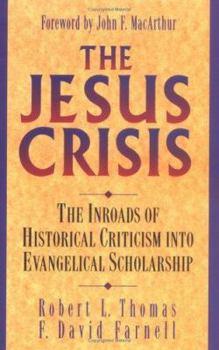
The Jesus Crisis

Select Format
Select Condition 
Book Overview
Examines the inroads of historical criticism into evangelical scholarship. Though evangelicals reject many extreme conclusions of liberal scholars, some have adopted their same methodology in the interpretation of the Synoptic Gospels, creating a crisis in evangelical scholarship. The authors show how adopting such methodologies are affecting the next generation of pastors, teachers, and scholars.
Format:Paperback
Language:English
ISBN:082543811X
ISBN13:9780825438110
Release Date:September 1998
Publisher:Kregel Publications
Length:416 Pages
Weight:1.20 lbs.
Dimensions:1.3" x 5.5" x 8.5"
Customer Reviews
4 ratings
When Sacred Cows Get Kicked...
Published by Thriftbooks.com User , 16 years ago
...People often get very angry. This book made a lot of 'conservative' evangelical scholars VERY angry, which is reason in itself to read it. Dr.'s Thomas, Farnell, Osborne, Felix and others take on the sacred cow of 'higher critical theory' and the issues around Markan priority and the various searches for the "Historical Jesus" (who apparently, is loosely related to the fella portrayed in Mathew, Mark, Luke and John). The basic thrust of the book is that dehistorizing of the scripture, fathered by Spinoza and embraced by the German and British Liberals of the 18th and 19th centuries, has infiltrated the biggest and best seminaries and havens of evangelicalism in the form of New Testament Higher Critical scholarship (i.e. the non-Matthean priority schools of thought, as well as the "Historical Jesus" searches/debates) and few people are the wiser. This book names the names, quotes texts and calls people to task for peddling dangerous and false teaching in the safety of classrooms and accademic journals. This book warns evangelicalism about the dangers of what's going on in the places where they faithfully send their money and find their clergy. I attended on of these seminaries where all the white haired, faithful saints got newsletters and supported a school, to the tune of millions of dollars, because they were blissfully unaware of what was being taught there. Students were coming hoping to "get to know the bible better" and study a bible that they thought was inspired, inerrant, sufficient, effications, historical and trustworthy (although few arrive knowing the theological terminology). Many of my friends and collegues left believing none of those things and many of them aren't involved in Christianity much, if at all, anymore. I remember sitting in a class and debating with professors about whether or not the canon was closed, the Bible was historically true, the scripture was sufficient for life and godliness, etc. Sadly, one of my profs even celebrated the "diversity" of all the theology in the school (if there is no actual truth, then who cares?). Evangelical scholarship has always run into problems when they start "trying to be cool" when the unbelieving accademic world is watching (i.e. trying to gain the respect of the unbelieving accademic world) We see it in events like Bruce Waltke's recent dismissal from RTS in Florida for not wanting to look stupid to the scientific community by embracing biblical creationism. We see it in RC Sproul, Gary Demar and Hank Hannegraaf for not wanting to look stupid to the skeptical/atheistic community because Matthew 24:34 didn't occur in the way that the skeptics/atheists think it should have, and embracing preterism. We see it in the life and accademic work of George Eldon Ladd; a man who died alone and in despair because the accademics at Princeton, Harvard and Oxford called him names instead of offered him a job. And we also see it all over New Testament studies in the "Synoptic
Question authority!
Published by Thriftbooks.com User , 23 years ago
The Synoptic Problem relates to why there is so much similar material in Matthew, Mark, and Luke's Gospels. Was there copying, and if so, who wrote in what order? The Jesus Crisis is a much needed work to counterbalance the prevailing "Q theory" or "2 source theory". This critical theory was conceived by non-believers, but has crept into Christian seminaries almost unnoticed. While its origin doesn't invalidate the theory, it should cause it to be examined closely. Unfortunately, that is not happening, as the Q theory has taken on canonical status. Thomas and company ask the important questions about the weaknesses in the prevailing solution to the Synoptic Problem. Even if they are eventually proven wrong, their willingness to go against the grain in the pursuit of truth is commendable.
A Wonderful and much needed ne analysis of Higher Criticism
Published by Thriftbooks.com User , 25 years ago
This is one of the best analysis of Higher Biblical Criticism available. Two evangelical Biblical scholars (Thomas & Farnell) tackle this issues quite ably. They begin by discussing the roots of Higher Biblical Criticism and the trends it has undergone up to the present day. Moreover, the authors do in fact cover B. Spinoza's influence on the overall issue, something that many books of this kind neglect (Spinoza could be considered one of the "father's" of Higher Criticism). Furthermore, the authors deal with the philosophical rub of higher criticism (i.e. philosophical hermeneutics) as well as the areas of source criticism and redaction criticism. Another positive aspect of the book is the fact that these authors discuss the well known Biblical scholar Eta Linnemann (former student of Rudolf Bultmann - I had the privilege of hearing her speak on these very issues). Linnemann has some of the strongest refutations of Higher Biblical Criticism still in print today. Lastly, these authors discuss the inroads of higher criticism into evangelical circles and the dangers and problems that it causes in the areas of apologetics, the gospel, preaching, and especially hermeneutics. While the topics at hand can be somewhat difficult, these authors have brought the issues back down to earth and written in such a way that a wide ranged audience will be able to enjoy the contents. This is a definitive work in this area, and a must read for evangelicals (and/or other Biblical conservatives) who find men like J. Crossan, M. Borg, R. Funk (the current adherents to many of the issues of Higher Biblical Criticism) and others intimidating. I highly recommend this book.
A must read for anyone studying or teaching the gospels.
Published by Thriftbooks.com User , 27 years ago
This book shows you the dangers found in much of evangelical scholarship regarding critical study of the gospels. It is an invaluable tool for anyone who wishes to understand how to approach a study of the gospels without compromising the integrity of the texts.
Copyright © 2026 Thriftbooks.com
Terms of Use | Privacy Policy | Do Not Sell/Share My Personal Information | Cookie Notice | Cookie Preferences | Accessibility Statement
ThriftBooks ® and the ThriftBooks ® logo are registered trademarks of Thrift Books Global, LLC
ThriftBooks ® and the ThriftBooks ® logo are registered trademarks of Thrift Books Global, LLC
