


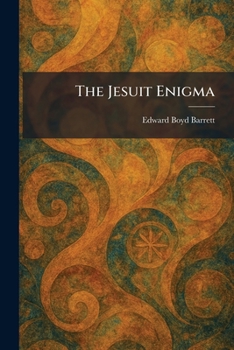
The Jesuit Enigma

Select Format
Select Condition 
Book Overview
"The Jesuit Enigma" offers a profound and critical investigation into the Society of Jesus, exploring its complex structure, rigorous discipline, and historical influence. Written from the perspective of an insider turned critic, the work provides a unique examination of the internal dynamics of the Jesuits, blending psychological observation with historical analysis. The book delves into the spiritual exercises of St. Ignatius of Loyola, the principles of absolute obedience, and the psychological impact of Jesuit training on its members.
Through a detailed examination of Jesuit methodology, "The Jesuit Enigma" seeks to unravel the mysteries surrounding one of the most influential and controversial religious orders in the Catholic Church. The text analyzes the tension between the individual and the institution, the order's educational missions, and its role in global religious politics. This work remains a significant contribution to the study of religious sociology and the history of Catholicism, offering readers an in-depth look at the philosophy and practice of the Society of Jesus. It is an essential read for those interested in the history of religious orders and the psychological dimensions of institutional faith.
This work has been selected by scholars as being culturally important, and is part of the knowledge base of civilization as we know it. This work was reproduced from the original artifact, and remains as true to the original work as possible. Therefore, you may see the original copyright references, library stamps (as most of these works have been housed in our most important libraries around the world), and other notations in the work.
This work is in the public domain in the United States of America, and possibly other nations. Within the United States, you may freely copy and distribute this work, as no entity (individual or corporate) has a copyright on the body of the work.
As a reproduction of a historical artifact, this work may contain missing or blurred pages, poor pictures, errant marks, etc. Scholars believe, and we concur, that this work is important enough to be preserved, reproduced, and made generally available to the public. We appreciate your support of the preservation process, and thank you for being an important part of keeping this knowledge alive and relevant.
Customer Reviews
ThriftBooks ® and the ThriftBooks ® logo are registered trademarks of Thrift Books Global, LLC
