


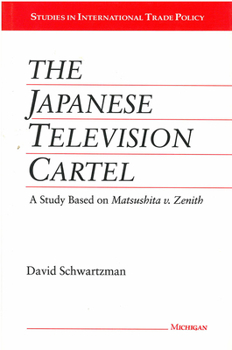
Japanese Television Cartel: A Study Based on "Matsushita v. Zenith" (Studies In International Economics)
No Customer Reviews

The Japanese Television Cartel examines the argument that Japanese television manufacturers dumped televisions in the United States as part of a long-run strategy to dominate the market. This issue is used to explore the related general issues-- ones of extraordinary importance that are continually in the forefront of public policy.David Schwartzman builds his argument around the landmark case of Matsushita v. Zenith, in which Zenith, by then the last remaining U.S. television manufacturer, contended that the Japanese manufacturer had manipulated the U.S. market to the detriment of domestic firms. Zenith lost, but the author insists the decision was erroneous and that dumping did occur.The Supreme Court refused to reverse the case; it took the view that because predation is unprofitable, the Japanese manufacturer could not have been guilty of that charge. The author nonetheless maintains that the analysis underlying this argument is predicated on a domestic dominant firm, the predatory losses of which would exceed those of the victimized fringe firms. But in the case of a foreign predator, its immediate losses would be smaller than those of its victims because its initial market share is small. This is just one of several criticisms of the basis of the Court's argument and a prime example of the applicability of the economic theory developed by the author.The Japanese Television Cartel deserves the attention of all who are concerned with U.S. policy on international trade and international economic competition.
Format:Hardcover
Language:English
ISBN:0472104543
ISBN13:9780472104543
Release Date:November 1993
Publisher:University of Michigan Press
Length:216 Pages
Weight:1.25 lbs.
Dimensions:9.0" x 1.0" x 6.0"
Customer Reviews
0 rating
Copyright © 2025 Thriftbooks.com
Terms of Use | Privacy Policy | Do Not Sell/Share My Personal Information | Cookie Policy | Cookie Preferences | Accessibility Statement
ThriftBooks ® and the ThriftBooks ® logo are registered trademarks of Thrift Books Global, LLC
ThriftBooks ® and the ThriftBooks ® logo are registered trademarks of Thrift Books Global, LLC
