


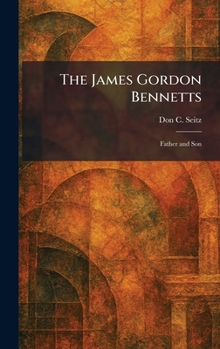
The James Gordon Bennetts: Father and Son

"The James Gordon Bennetts: Father and Son" offers a dual biography of two of the most influential and controversial figures in the history of American journalism. Don C. Seitz provides a detailed chronicle of the lives of James Gordon Bennett, the founder of the "New York Herald", and his son, James Gordon Bennett Jr., who carried the publication into a new era of global news gathering. This work examines how the elder Bennett revolutionized the newspaper industry through the introduction of the modern reporting style, financial news, and sensational headlines, while his son expanded the paper's reach by sponsoring legendary expeditions, such as Henry Morton Stanley's search for David Livingstone.
Through a blend of personal anecdote and historical analysis, Seitz portrays the Bennetts not just as media moguls, but as complex personalities whose vision shaped the public consciousness of the nineteenth and early twentieth centuries. The book explores the transition of the "New York Herald" from a disruptive startup to a global powerhouse, illustrating the development of the independent press in the United States. It is a vital resource for readers interested in the evolution of the media, the history of New York City, and the biographical accounts of the men who defined the Gilded Age press.
This work has been selected by scholars as being culturally important, and is part of the knowledge base of civilization as we know it. This work was reproduced from the original artifact, and remains as true to the original work as possible. Therefore, you may see the original copyright references, library stamps (as most of these works have been housed in our most important libraries around the world), and other notations in the work.
This work is in the public domain in the United States of America, and possibly other nations. Within the United States, you may freely copy and distribute this work, as no entity (individual or corporate) has a copyright on the body of the work.
As a reproduction of a historical artifact, this work may contain missing or blurred pages, poor pictures, errant marks, etc. Scholars believe, and we concur, that this work is important enough to be preserved, reproduced, and made generally available to the public. We appreciate your support of the preservation process, and thank you for being an important part of keeping this knowledge alive and relevant.
Related Subjects
Biographical Biographies Biographies & History Biography & History History Language ArtsCustomer Reviews
ThriftBooks ® and the ThriftBooks ® logo are registered trademarks of Thrift Books Global, LLC
