


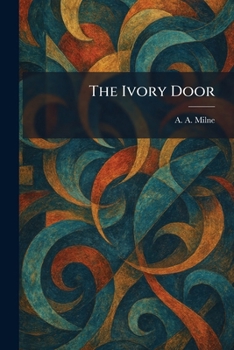
The Ivory Door

"The Ivory Door" is a charming and thought-provoking three-act play by the celebrated author A. A. Milne. Set in a fictional kingdom steeped in tradition and superstition, the story centers on the enigmatic Ivory Door located within the castle walls. For generations, legend has dictated that anyone who passes through the door will never return, or will be transformed into something else entirely. On the day of his wedding, the inquisitive King Perivale decides to challenge the ancient myth and step through the door to discover the truth for himself.
Combining elements of a fairy tale with sophisticated wit, Milne explores profound themes such as the power of belief, the nature of reality, and the struggle between established legend and individual truth. As Perivale and his bride, Princess Lilia, confront the consequences of their curiosity, the play questions whether people prefer a comfortable lie over a simple truth. This lyrical and philosophical drama showcases Milne's signature mastery of dialogue and his ability to weave deep meaning into a whimsical narrative, making "The Ivory Door" a timeless exploration of human nature and the stories we choose to believe.
This work has been selected by scholars as being culturally important, and is part of the knowledge base of civilization as we know it. This work was reproduced from the original artifact, and remains as true to the original work as possible. Therefore, you may see the original copyright references, library stamps (as most of these works have been housed in our most important libraries around the world), and other notations in the work.
This work is in the public domain in the United States of America, and possibly other nations. Within the United States, you may freely copy and distribute this work, as no entity (individual or corporate) has a copyright on the body of the work.
As a reproduction of a historical artifact, this work may contain missing or blurred pages, poor pictures, errant marks, etc. Scholars believe, and we concur, that this work is important enough to be preserved, reproduced, and made generally available to the public. We appreciate your support of the preservation process, and thank you for being an important part of keeping this knowledge alive and relevant.
Customer Reviews
ThriftBooks ® and the ThriftBooks ® logo are registered trademarks of Thrift Books Global, LLC
