


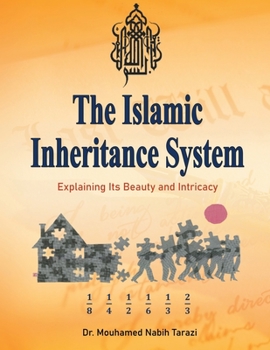
The Islamic Inheritance System: Explaining Its Beauty and Intricacy
No Customer Reviews

This book explains the beauty and intricacy of the Islamic Inheritance System. Among other things, the book presents and discusses: THE DIFFERENCES IN INHERITANCE AMONG HEIRS, BASED ONThe degree of kinship to the deceasedThe generation to which the heirs belongFinancial responsibilityTHE DIFFERENT KINDS OF HEIRSQuota-heirs Q-heirs] (Ashab al-furud أصحاب الفروض)Four types of male and eight types of female relatives have a prescribed portion of the inheritance (1/8, 1/4, 1/2, 1/6, 1/3, and 2/3), and the distribution of the inheritance starts with them.Residuary-heirs R-heirs] (Asabah العصبة)R-heirs share the balance of the inheritance (if any) after all Q-heirs get their portions.Extended-heirs E-heirs] (Zawularham ذوو الأرحام )These are family members who are neither Q-heirs nor R-heirs. EXCLUSION RULES (Al-Hajib الحجب)
While some heirs cannot be excluded from the inheritance (i.e., parents, children, and spouses), others may be excluded. The existence of a specific heir may cause the exclusion of others. The Islamic Inheritance System provides a detailed mechanism for the exclusion rules. FLOWCHARTS AND ALGORITHMS
Flowcharts and algorithms for the inheritance and exclusion rules are provided. WOMEN'S INHERITANCE
In only four scenarios, a male will inherit twice as much as a female, typically where the male becomes financially responsible for the female (such as between a brother and a sister). There are dozens of other cases where a female inherits the same as or more than a male or where she inherits, and he does not. Examples are provided. APPLICATIONS
Several cases illustrating practical examples applying the inheritance principles are presented. TEST YOURSELF
Twelve exercises and their answers are provided.
While some heirs cannot be excluded from the inheritance (i.e., parents, children, and spouses), others may be excluded. The existence of a specific heir may cause the exclusion of others. The Islamic Inheritance System provides a detailed mechanism for the exclusion rules. FLOWCHARTS AND ALGORITHMS
Flowcharts and algorithms for the inheritance and exclusion rules are provided. WOMEN'S INHERITANCE
In only four scenarios, a male will inherit twice as much as a female, typically where the male becomes financially responsible for the female (such as between a brother and a sister). There are dozens of other cases where a female inherits the same as or more than a male or where she inherits, and he does not. Examples are provided. APPLICATIONS
Several cases illustrating practical examples applying the inheritance principles are presented. TEST YOURSELF
Twelve exercises and their answers are provided.
Format:Paperback
Language:English
ISBN:B0C1J1XN7T
ISBN13:9798388665713
Release Date:April 2023
Publisher:Independently Published
Length:62 Pages
Weight:0.37 lbs.
Dimensions:0.1" x 8.5" x 11.0"
Customer Reviews
0 rating
Copyright © 2026 Thriftbooks.com
Terms of Use | Privacy Policy | Do Not Sell/Share My Personal Information | Cookie Policy | Cookie Preferences | Accessibility Statement
ThriftBooks ® and the ThriftBooks ® logo are registered trademarks of Thrift Books Global, LLC
ThriftBooks ® and the ThriftBooks ® logo are registered trademarks of Thrift Books Global, LLC
