


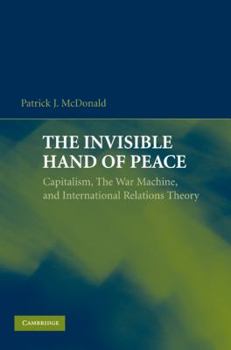
The Invisible Hand of Peace: Capitalism, the War Machine, and International Relations Theory
No Customer Reviews

Select Format
Select Condition 
Book Overview
The Invisible Hand of Peace shows that the domestic institutions associated with capitalism, namely private property and competitive market structures, have promoted peace between states over the past two centuries. It employs a wide range of historical and statistical evidence to illustrate both the broad applicability of these claims and their capacity to generate new explanations of critical historical events, such as the emergence of the Anglo-American friendship at the end of the nineteenth century, the outbreak of World War I, and the evolution of the recent conflict across the Taiwan Strait. By showing that this capitalist peace has historically been stronger than the peace among democratic states, these findings also suggest that contemporary American foreign policy should be geared toward promoting economic liberalization rather than democracy in the post-9/11 world.
Format:Paperback
Language:English
ISBN:0521744121
ISBN13:9780521744126
Release Date:March 2009
Publisher:Cambridge University Press
Length:354 Pages
Weight:1.32 lbs.
Dimensions:0.9" x 6.0" x 9.0"
Customer Reviews
0 rating
Copyright © 2026 Thriftbooks.com Terms of Use
| Privacy Policy | Do Not
Sell/Share My Personal Information | Cookie Policy | Cookie Preferences | Accessibility Statement
ThriftBooks® and the ThriftBooks® logo are registered trademarks of Thrift Books Global, LLC
ThriftBooks® and the ThriftBooks® logo are registered trademarks of Thrift Books Global, LLC
