


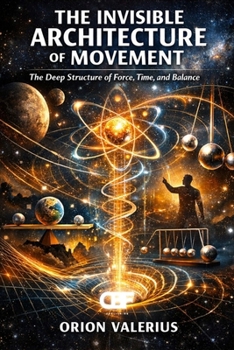
The Invisible Architecture of Movement: The Deep Structure of Force, Time, and Balance

Build a clear, intuitive understanding of classical mechanics-from how motion is defined to why objects balance, accelerate, collide, and rotate. This physics guide connects kinematics, dynamics, Newton's laws, forces, energy, momentum, torque, equilibrium, and stability into one coherent framework, helping you "see" the deep structure behind everyday movement.
Inside you'll explore reference frames (and why they matter), the difference between average vs. instantaneous speed, how acceleration shapes trajectories, how to analyze contact and field forces, and how conservation laws tie motion, energy, and momentum together-ending with a practical view of balance, center of gravity, and stability.
What you will learn
Define motion correctly using reference frames and understand relative vs. absolute motion debatesDistinguish speed, velocity, and acceleration; analyze uniform/non-uniform and curvilinear motionUnderstand the concept of force, including superposition, contact forces, and field forcesUse free-body diagrams to model interactions and apply Newton's laws of motionMaster work, kinetic energy, potential energy, energy transformations, and conservation of energyLearn momentum, impulse, and how to reason about collisionsAnalyze torque (moment), static/dynamic equilibrium, center of gravity, and types of stabilityQuestions you'll be able to answer
Which reference frame makes a motion description meaningful-and what changes when the frame changes?What is the real difference between instantaneous speed and average speed?How do multiple forces combine, and how do you draw a correct free-body diagram?When should you use Newton's laws vs. an energy approach?What stays conserved in a collision, and how does impulse explain sudden changes?Why do objects tip over, remain stable, or return to equilibrium?Customer Reviews
ThriftBooks ® and the ThriftBooks ® logo are registered trademarks of Thrift Books Global, LLC
