


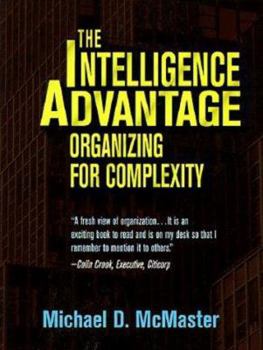
The Intelligence Advantage: Organizing for Complexity

Select Format
Select Condition 
Book Overview
Through the study of new ideas and advances in philosophy, science and technology, this book offers an understanding of the way that human beings create organizations. It gives a sense of clarity... This description may be from another edition of this product.
Format:Paperback
Language:English
ISBN:075069792X
ISBN13:9780750697927
Release Date:January 1996
Publisher:Butterworth-Heinemann
Length:224 Pages
Weight:2.20 lbs.
Dimensions:9.5" x 0.8" x 7.3"
Customer Reviews
4 ratings
GREAT INSIGHTS INTO ACHIEVING ORGANIZATIONAL SUCCESS!
Published by Thriftbooks.com User , 17 years ago
An intriguing exploration of organization using advances in philosophy, new science and technology. Aim is to foster insight into ways of organizing productive activity consistent with the nature of human beings and society. Focuses on organizations as complex adaptive systems, emphasizing the capacity to learn, innovate, generate knowledge, and act successfully in a highly competitive environment. Key chapter topics: leadership, learning, freedom, and innovation, creativity and flexibility. This book has enduring value and is as informative and insightful in 2008 as when first published.
How to herd cats! Leading self-organizing organizations.
Published by Thriftbooks.com User , 26 years ago
A clearly written, conceptually lucid, practical guide to leading self-organizing organizations which can respond effectively to the demands of their environment. McMaster emphasizes that changed thinking and speaking precede changed organizations. Mechanical thinking won't make it in an age which demands organically structured organizations utilizing every ounce of intelligence of every member. Leaders who want control will wind up with no organization to lead; leaders who want to enable everyone in the organization to operate at their own maximum of creativity, freedom and productivity (no contradiction here) will survive and thrive. Amen. Applicable to non-profits and other organizations as well as businesses
it has a unique and powerful articulation on organizations
Published by Thriftbooks.com User , 27 years ago
This is one of the unique and powerful works on living organizations. It should be read by everyone who likes original contributions to the literature.
McMaster rivals Nonaka's Knowledge-Creating Company
Published by Thriftbooks.com User , 28 years ago
Arie de Geus, whose view of The Living Company appears in Harvard Business Review M/A 1997 says of this book: "We will fail to realise the potential of organisations until we see them as organisms in their own right and intelligence is the source of an organisation's capacity for survival. These are the basic hypotheses in Mike McMaster's thinking which, then, leads towards his illuminating ideas on organisational design and away from much of the mechanistic thinking of recent management theory". Sample David's view on innovation (page 133): "Corporations that are known for innovation are specifically designed to create occasions for innovation and support innovative activities. They include reward systems, communication practices, investment, blending people and ideas and appropriate reporting structures. In corporations not specifically designed for innovation, the innovative capacity is mostly displayed by individuals who are sufficiently powerful to get their ideas accepted. Given the lack of design to support such activity, the relative organisational innovative expression in such corporations is quite low." McMasters goes on to define innovation but notice some carefully chosen nuances in the words he uses; "Our operational definition of innnovation is THAT ACTIVITY WHICH RESULTS IN A CHANGE THAT HAS USEFULNESS BEYOND A CURRENT APPICATION AND THAT ALTERS THE ABILITY OF THE SYSTEM AS A WHOLE". Innovation increases the flexibility, complexity or computational ability of the larger system." Innovation is not therefore a natural thing for corporate boards to direct if they are paying too much attention to counting up last quarter's figures or downsizing your future. Anyway, McMasters goes on to discuss many other subtleties regarding creativity. For example : "In a group or team, creativity occurs in dialogue itself. An individual may have originated and be indentified with a creative idea. Yet, if an idea is a group creation, it is the result of the interplay of the participants, both for and against the idea. Each individual has contributed to the thinking, the creative process and the creation itself in ways that are not always obvious." If you feel passionately about questioning the value of constructs like these - would you like to join a worldwide e-mail summit on ORGANISING CREATIVITY? To do so e-mail me, Chris Macrae, editor of Brand Chartering Handbook & MELNET www.brad.ac.uk/branding/ E-mail me at wcbn007@easynet.co.uk
Copyright © 2026 Thriftbooks.com Terms of Use
| Privacy Policy | Do Not
Sell/Share My Personal Information | Cookie Policy | Cookie Preferences | Accessibility Statement
ThriftBooks® and the ThriftBooks® logo are registered trademarks of Thrift Books Global, LLC
ThriftBooks® and the ThriftBooks® logo are registered trademarks of Thrift Books Global, LLC
