


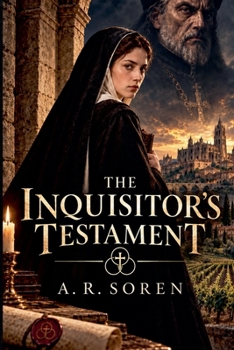
The Inquisitor's Testament

Her father built the record. His enemies rewrote his death. She will make the truth impossible to erase.
1495 In the Kingdom of Aramonte, Catalina has spent most of her life inside the walls of Santa Clara, preparing to take solemn vows and believing that whatever future awaits her will be shaped by the convent that raised her.
Then Sister Teresa dies.
Before her death, the woman who raised Catalina leaves behind a hidden notarial instrument, a warning not to take her vows yet, and the first proof that Catalina's life has been built around a secret.
The trail leads to lvaro de Castrill n-former Inquisitor-General, architect of confiscations, political terror and religious persecution.
And Catalina's father.
The discovery forces her to confront two incompatible truths. lvaro funded her childhood, protected her from his enemies and quietly prepared a future beyond the convent. He also built and defended an institution that destroyed other families, stripped dependants of property and turned fear into administrative routine.
With the help of Mateo de Aranda, a young legal clerk whose insistence on evidence repeatedly checks Catalina's instincts, she begins following the paper trail her father left behind.
What starts with one hidden document grows into a dangerous investigation through notarial archives, cathedral records, convent accounts, private ledgers, estate papers and testimony from men and women who survived the machinery of the Holy Office.
The official record says lvaro died of fever.
The surviving evidence says otherwise.
A physician remembers improvement before an unrequested treatment. An apothecary ledger records a second preparation outside the ordinary course of care. A servant remembers who carried it. A confessor remembers the question lvaro asked before accepting it. And buried beneath years of revised statements, missing pages and jurisdictional conflict lies the outline of a political settlement designed to end more than a man's career.
As the Royal Council and the Holy Office close in, Catalina discovers that uncovering the truth is not the same as achieving justice.
Every revelation carries a cost.
Friends lose work. The convent loses pupils. Witnesses risk scrutiny. Property rights become unstable. And the more Catalina learns about the father who protected her, the harder it becomes to decide what protection means when it is created by a man who denied the same mercy to others.
To preserve the truth, Catalina must do what her father never fully learned to do: give other people a choice in the risks they are being asked to bear.
The Inquisitor's Testament is an intelligent historical mystery and political thriller about evidence, power, inheritance, institutional memory and the danger of allowing one official record to become the only truth.
For readers who enjoy morally complex historical fiction, archival mysteries, ecclesiastical intrigue, slow-burn investigations and protagonists forced to choose between belonging, loyalty and intellectual honesty.
Customer Reviews
ThriftBooks ® and the ThriftBooks ® logo are registered trademarks of Thrift Books Global, LLC
