


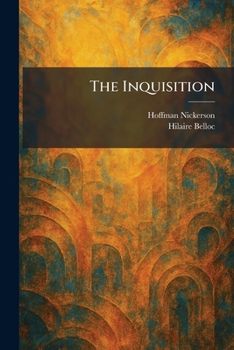
The Inquisition

Select Format
Select Condition 
Book Overview
"The Inquisition" provides a deep historical investigation into the origins, development, and impact of the ecclesiastical courts established to combat heresy. Written by Hoffman Nickerson with a significant contribution from the noted historian Hilaire Belloc, this work seeks to place the Inquisition within its proper medieval context, exploring the social and political pressures that led to its creation. The book focuses heavily on the Albigensian Crusade and the perceived threat posed by the Cathar heresy to the stability of Western Christendom.
Through a detailed examination of the legal procedures and the philosophical justifications used by the Church and state authorities, the authors analyze how the Inquisition functioned as both a religious and social instrument. This study goes beyond simple condemnation or defense, instead offering a nuanced look at the motivations of its actors and the prevailing worldviews of the time. "The Inquisition" remains a vital resource for readers interested in Church history, medieval legal systems, and the complex relationship between religious orthodoxy and dissent in European history.
This work has been selected by scholars as being culturally important, and is part of the knowledge base of civilization as we know it. This work was reproduced from the original artifact, and remains as true to the original work as possible. Therefore, you may see the original copyright references, library stamps (as most of these works have been housed in our most important libraries around the world), and other notations in the work.
This work is in the public domain in the United States of America, and possibly other nations. Within the United States, you may freely copy and distribute this work, as no entity (individual or corporate) has a copyright on the body of the work.
As a reproduction of a historical artifact, this work may contain missing or blurred pages, poor pictures, errant marks, etc. Scholars believe, and we concur, that this work is important enough to be preserved, reproduced, and made generally available to the public. We appreciate your support of the preservation process, and thank you for being an important part of keeping this knowledge alive and relevant.
Customer Reviews
ThriftBooks ® and the ThriftBooks ® logo are registered trademarks of Thrift Books Global, LLC
