


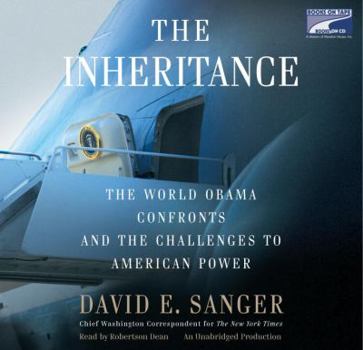
The Inheritance: The World Obama Confronts and the Challenges to American Power

Select Format
Select Condition 
Book Overview
Readers of The New York Times know David Sanger as one of the most trusted correspondents in Washington, one to whom presidents, secretaries of state, and foreign leaders talk with unusual candor. Now, with a historian's sweep and an insider's eye for telling detail, Sanger delivers an urgent intelligence briefing on the world America faces. In a riveting narrative, The Inheritance describes the huge costs of distraction and lost opportunities at home and abroad as Iraq soaked up manpower, money, and intelligence capabilities. The 2008 market collapse further undermined American leadership, leaving the new president with a set of challenges unparalleled since Franklin D. Roosevelt entered the Oval Office. Sanger takes readers into the White House Situation Room to reveal how Washington penetrated Tehran's nuclear secrets, leading President Bush, in his last year, to secretly step up covert actions in a desperate effort to delay an Iranian bomb. Meanwhile, his intelligence chiefs made repeated secret missions to Pakistan as they tried to stem a growing insurgency and cope with an ally who was also aiding the enemywhile receiving billions in American military aid. Now the new president faces critical choices: Is it better to learn to live with a nuclear Iran or risk overt or covert confrontation? Is it worth sending U.S. forces deep into Pakistani territory at the risk of undermining an unstable Pakistani government sitting on a nuclear arsenal? It is a race against time and against a new effort by Islamic extremistsnever before disclosedto quietly infiltrate Pakistan's nuclear weapons program. "Bush wrote a lot of checks," one senior intelligence official told Sanger, "that the next president is going to have to cash." The Inheritance takes readers to Afghanistan, where Bush never delivered on his promises for a Marshall Plan to rebuild the country, paving the way for the Taliban's return. It examines the chilling calculus of North Korea's Kim Jong-Il, who built actual weapons of mass destruction in the same months that the Bush administration pursued phantoms in Iraq, then sold his nuclear technology in the Middle East in an operation the American intelligence apparatus missed. And it explores how China became one of the real winners of the Iraq war, using the past eight years to expand its influence in Asia, and lock up oil supplies in Africa while Washington was bogged down in the Middle East. Yet Sanger, a former foreign correspondent in Asia, sees enormous potential for the next administration to forge a partnership with Beijing on energy and the environment. At once a secret history of our foreign policy misadventures and a lucid explanation of the opportunities they create, The Inheritance is vital reading for anyone trying to understand the extraordinary challenges that lie ahead. From the Hardcover edition.
Format:Hardcover
Language:English
ISBN:0307407926
ISBN13:9780307407924
Release Date:January 2009
Publisher:Crown
Length:528 Pages
Weight:1.85 lbs.
Dimensions:9.6" x 1.8" x 6.6"
Customer Reviews
4 ratings
informative
Published by Thriftbooks.com User , 16 years ago
My husband and I both felt this book was both frightening and informative. I definitely recommend to any American interested in what is going on
The Inheritance
Published by Thriftbooks.com User , 16 years ago
Totally excellent book! Easy reading and extremely timely with the current world events. After reading this book, I have a much deeper understanding of the what and why of failed states, history and dynamics of relations in N. Korea, Afghanistan, Pakistan, and China. I would recommend this book to anyone who desires a deeper understanding of world politics and US responces.
The price of Distraction
Published by Thriftbooks.com User , 17 years ago
David Sanger is a veteran NYTimes correspondent . In this work he assesses the security- situation of the United States by examining the actions of the Bush Administration and outlining its legacy to the incoming Obama administration. This legacy includes according to Sanger many problems which have been worsened by the Bush Administration. It also includes a number of covert programs including one aimed to deal with the Iranian nuclear threat. As I understand it Sanger's major idea, the one that holds everything together is that the Bush Administration has been distracted by Iraq. It has given Iraq so much of its attention and resources that other areas and problems, potentially more serious, Afghanistan and Pakistan, Iran, North Korea, relations with China and with Russia - have been neglected. Iran has pushed ahead with its nuclear program defying U.N. reports and U.S. attempts at sanctions. As Sanger sees it both our sticks and our carrots were far too small. He believes it was a mistake not to speak with Iran and suggests that now that Iran has been a bit humbled by the fallen price of Oil, there is some possibility for dealing with them. Sanger relates in regard to the Iran crisis a visit of Israeli Prime- Minister Olmert to the White House in the Spring of 2008. President Bush refused the Israel Prime Minister's request to fly over Iraqi airspace in order to attack the Iranian enrichment facility at Natanz. Bush was concerned about attacks by Iran on U.S. troops, and also the possible expulsion of U.S. troops from Iraq by enraged Iraqis. Bush tried to assure Olmert that the U.S. has a covert program which will stop the Iranian effort. Sanger himself seems to be resigned to the idea that Iran will attain nuclear weapons and has succeeded in fooling the U.S. and the U.N. As Iran seems absolutely determined to have a nuclear option, and a nuclear Iran would bring nuclear terror and a nuclear arms race in the Middle East with it- this is certainly one of the major problems facing President Obama. But there is also the very questionable ally Pakistan and its nuclear weapons. Sanger tells of a special unit of the United States military whose job would be to seize the nuclear weapons should the Pakistani regime melt down. However it is not clear that the American military knows exactly where these weapons are. Our ally refuses to tell. This is much much more in this tremendously fascinating and important book, including considerations of how Terrorists might bring disaster to the United States. I would only add two points in regard to President Bush. One of his major points of pride is that after 9/11 Terrorists were prevented from hitting the United States. He one day might be given great credit this, should God forbid, the Terrorists one day succeed and pull off some great disaster in the U.S. Secondly, and this not in President Bush's favor. He promised many times to prevent Iran from attaining nuclear weapons. If they should do so, this ma
Must Reading!
Published by Thriftbooks.com User , 17 years ago
Sanger describes what President-Elect Obama will face - results of the costs of distraction and lost opportunities in Iraq. He does not cover our weakened position due to the 2008 market collapse. His best material involves the latest developments in Iran. The 2007 NIE report on Iran reported that they had ceased working on a bomb in 2003, but omitted the fact that this is the easiest portion - far easier than creating the required enriched fissionable material, especially given the availability of Russian experts and Pakistani help. The classified version also alleged Iran had added covert enrichment sites to the main (known) one. After crying wolf re Iraq, U.S. intelligence was unable to raise the alarm about Iran. The "good news" is that the U.S. tunneled into Irani computer systems and obtained extensive background information. President Bush then decided to try sabotaging Iran's efforts - eg. arranging power supplies that generated unstable electricity that destroyed centrifuges (about 50) when turned on. The "bad news" is that Iran is now estimated to have 4,000 active centrifuges - enough to build a bomb/year, and is building new centrifuges that are even better. Experts see Iran as having enough material for a few weapons by 2010-12, and being set back only two years by a bombing campaign that would create enormous new problems in Iraq and elsewhere. During the Spring 2008, Israel requested precision bunker-busting bombs and Iraq overflight rights to do the job themselves. President Bush refused. The U.S. started Iran down the nuclear path in the 1950s; fortunately, Khomeini ignored it when the Shah was deposed. However, Saddam's use of chemical weapons on Iran rekindled interest. The U.S. had an opportunity to obtain Iran's cooperation post 9/11, especially at the time of "Mission Accomplished." Cheney, however, believed the Iranians were on the verge of collapse and successfully argued for ignoring their proposal. Sanger now sees the U.S. at another point of strength in negotiating vs. Iran - their economy is at a nadir with the recent drop in oil prices. Meanwhile, our intelligence chiefs have made repeated secret trips to Pakistan to try and stem a growing insurgency and cope with an ally aiding the enemy. "The Inheritance" also takes readers to Afghanistan, where Bush II never delivered on his promises to rebuild, paving the way for the Taliban's return. General McNeil (2008) tells Sanger that managing troops from 26 nations (mostly NATO), most of whom are under instructions to avoid regions where casualties were likely, and often also required advance approval from their capitals, is not a good way to win a war. The Afghan government revenue in 2008 was $716 million, vs. a $4 billion narco-trade (per CIA). (Couldn't the NATO troops at least be used to clear the poppy fields?) Bush promised a "Marshal Plan" for Afghanistan ($90 billion in today's dollars), but months after that speech the U.S. had pledged only
Copyright © 2026 Thriftbooks.com Terms of Use
| Privacy Policy | Do Not
Sell/Share My Personal Information | Cookie Policy | Cookie Preferences | Accessibility Statement
ThriftBooks® and the ThriftBooks® logo are registered trademarks of Thrift Books Global, LLC
ThriftBooks® and the ThriftBooks® logo are registered trademarks of Thrift Books Global, LLC
