


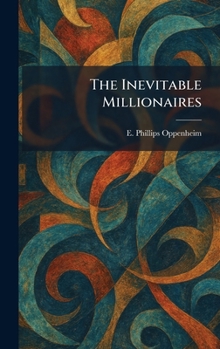
The Inevitable Millionaires

"The Inevitable Millionaires" is a witty and charming social comedy by the prolific E. Phillips Oppenheim. The story centers on two middle-aged bachelor brothers, Stephen and George Henry Underhill, who lead a quiet, frugal existence in London. Their lives are suddenly transformed when they inherit a massive fortune from their late father, tied to a most unusual condition: they must learn how to spend it lavishly and speculatively rather than hoarding it.
As the brothers embark on a series of earnest attempts to be extravagant, they find themselves in a delightful predicament. Whether they are investing in failing theatrical productions, supporting struggling artists, or backing high-risk business ventures, their efforts to lose money consistently result in even greater profits. Oppenheim masterfully explores the irony of their situation, illustrating that for some, financial success is an inescapable fate. Through sharp dialogue and satirical observations of the 1920s social scene, the novel provides an entertaining look at class, character, and the unexpected burdens of sudden riches. "The Inevitable Millionaires" remains a clever exploration of the financial world and a testament to Oppenheim's versatility as a storyteller beyond the realm of espionage and thrillers.
This work has been selected by scholars as being culturally important, and is part of the knowledge base of civilization as we know it. This work was reproduced from the original artifact, and remains as true to the original work as possible. Therefore, you may see the original copyright references, library stamps (as most of these works have been housed in our most important libraries around the world), and other notations in the work.
This work is in the public domain in the United States of America, and possibly other nations. Within the United States, you may freely copy and distribute this work, as no entity (individual or corporate) has a copyright on the body of the work.
As a reproduction of a historical artifact, this work may contain missing or blurred pages, poor pictures, errant marks, etc. Scholars believe, and we concur, that this work is important enough to be preserved, reproduced, and made generally available to the public. We appreciate your support of the preservation process, and thank you for being an important part of keeping this knowledge alive and relevant.
Customer Reviews
ThriftBooks ® and the ThriftBooks ® logo are registered trademarks of Thrift Books Global, LLC
