


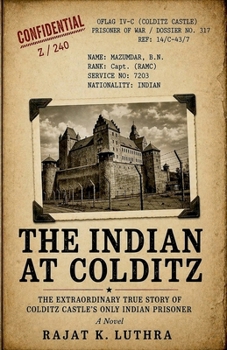
The Indian at Colditz

He walked toward the tanks because no one else was walking toward the tanks.
In May 1940, on a road in northern France, an Indian medical officer tied a khaki handkerchief to a stick and walked toward a German Panzer column while forty ambulances burned behind him. The commander who stopped him was polite. He said please. It was the last courtesy Birendranath Mazumdar would receive for a very long time.
Colditz Castle was supposed to be the prison you escaped from. The British officers who filled it had tunnels, disguises, forged papers, an escape committee, and one another. Mazumdar had none of these things. They called him Jumbo. They put him in the kitchen. They told him his face made escape impossible. He slept in the coldest bunk in the highest attic and did not complain, because complaining was not a thing his body knew how to do.
Then Berlin. A dinner with Subhas Chandra Bose - fish, coffee, cigarettes, and an offer that would have freed him from everything. He refused. He returned to the castle. He stopped eating for sixteen days. He crawled through wire in the dark with a Sikh cavalryman and walked nine hundred kilometres across occupied France to the Swiss border.
After the war, he married an Englishwoman named Ruth. He became a country doctor in Devon. He told her nothing. Not the tanks, not the castle, not the dinner in Berlin, not the sixteen days, not the wire. For fifty years, the most extraordinary story of the Second World War lived inside a man who cleaned his plate at every meal and held his wife's hand in the dark and said nothing.
The Indian at Colditz is a novel about the cost of an oath kept by a man nobody asked to keep it. It is about the silence that follows survival, and the marriage that grows around that silence the way a tree grows around wire. It is about India's invisible millions - the two and a half million soldiers who fought the Second World War and whose names do not appear in the books that made Colditz famous.
Based on historical records held at the National Archives at Kew, the Imperial War Museum, and the published Colditz memoirs. The second publication from Yoddha Labs, following The Twenty Four (2026).
Customer Reviews
ThriftBooks ® and the ThriftBooks ® logo are registered trademarks of Thrift Books Global, LLC
