


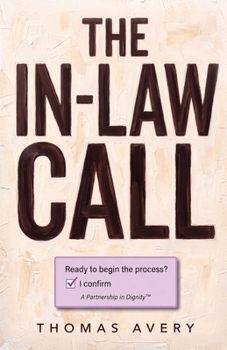
The In-Law Call: A Novel

In a near-future America, you hold the legal power to end your your in-laws' lives. Would you click?
It works like this: When someone turns seventy-five, the Dignity Commission, a government-run agency, assigns their Compassion Companion. Not their child. Their child's spouse. Their in-law. The Companion holds a sixteen-digit code that they can enter into an online portal. The code tells the Dignity Commission that the family has decided it is time for their parent-in-law to go. Designed to curb the endless costs of dementia in old age, the law gives Companions the ultimate power over their in-laws. Is this law cruel or kind?
Julie Bergman has spent sixteen years navigating her mother-in-law: Gloria, retired judge, sharp as a tack, maker of legendary casseroles. Gloria has just turned seventy-five, and Julie holds the code. She also can't tell whether anything is actually happening to Gloria, or whether she's looking too hard at a woman she's never quite been able to read.
Marco Castillo teaches high school history. His father-in-law, Arturo, retired contractor, baseball coach, maker of Sunday sauce from scratch, is losing words. Not many. Not the ones that matter, not yet. But the assessment scores are dropping seven points at a time, and Marco knows what that math means.
Told in alternating chapters, The In-Law Call follows two families through the architecture of an impossible system: the orientations, the assessments, the forums where strangers trade advice at 2 a.m., and the kitchens where the real conversations happen.
Marco was chosen because he's known Arturo for fourteen years and loves him like a father. Julie was chosen for the opposite reason, for the distance an in-law is supposed to have. Both will find out the system was wrong about what that distance meant.
The system calls it dignity. The families call it Sunday.
For readers of Kazuo Ishiguro's Klara and the Sun, Sigrid Nunez's The Friend, and Elizabeth Strout's Olive, Again.
Customer Reviews
ThriftBooks ® and the ThriftBooks ® logo are registered trademarks of Thrift Books Global, LLC
