


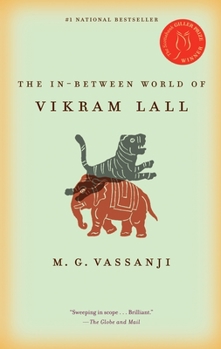
The In-Between World of Vikram Lall

Select Format
Select Condition 
Book Overview
Double Giller Prize winner M.G. Vassanji's The In-Between World of Vikram Lall is a haunting novel of corruption and regret that brings to life the complexity and turbulence of Kenyan society in the last five decades. Rich in sensuous detail and historical insight, this is a powerful story of passionate betrayals and political violence, racial tension and the strictures of tradition, told in elegant, assured prose. The novel begins in 1953, with eight-year-old Vikram Lall a witness to the celebrations around the coronation of Queen Elizabeth II, just as the Mau Mau guerilla war for independence from Britain begins to gain strength. In a land torn apart by idealism, doubt, political upheaval and terrible acts of violence, Vic and his sister Deepa must find their place among a new generation. Neither colonists nor African, neither white nor black, the Indian brother and sister find themselves somewhere in between in their band of playmates: Bill and Annie, British children, and Njoroge, an African boy. These are the relationships that will shape the rest of their lives. We follow Vikram through the changes in East African society, the immense promise of the fifties and sixties. But when that hope is betrayed by the corruption and violence of the following decades, Vic is drawn into the Kenyatta government's orbit of graft and power-broking. Njoroge, his childhood friend, can abandon neither the idealism of his youth nor his love for Vic's sister Deepa. But neither the idealism of the one nor the passive cynicism of the other can avert the tragedies that await them. In interviews given when the novel was published, Vassanji commented that The In-Between World of Vikram Lall is the first of his books to deal with his memories of Kenya, where he spent the first 5 years of his life: "I remember these images of fear, of terror. And I thought I had to come back to that and see the whole Mau Mau episode from the Asian point of view. I had never written a book set in Kenya, where my father was from. And when I did, I just felt good about it, because I was going back to one part, one of many homes." The In-Between World of Vikram Lall, a compelling record in the voice of a character described as "a cheat of monstrous and reptilian cunning," took three years to write. After research in Kenya and Britain, M.G. Vassanji devoted himself to the novel in a dark office at the University of Toronto. It was a hard process of creation and discovery, especially as Vassanji is an assiduous editor of his own work: "I come back to it over and over. For me, it's like working on a sculpture. You sort of chip away a bit at a time until you tell yourself it's as perfect as you can make it." Vassanji's fifth novel met with immense Canadian and international success. As well as making him the first author to win the Giller Prize twice, the book was a #1 national bestseller.
The In-Between World of Vikram Lall is a profound and careful examination of one man's search for his place in the world; it also takes up themes that have run through Vassanji's work, such as the nature of community in a volatile society, the relations between colony and colonizer, and the inescapable presence of the past. It is also, finally, a deeply personal book: "The major thing that stands out in the book is people who are in-between. The feeling of belonging and not belonging is very central to the book. And that also played out in my life. When we lived in Tanzania we belonged and did not belong because we had come from Kenya. That has been a major thread in my life."
The In-Between World of Vikram Lall is a profound and careful examination of one man's search for his place in the world; it also takes up themes that have run through Vassanji's work, such as the nature of community in a volatile society, the relations between colony and colonizer, and the inescapable presence of the past. It is also, finally, a deeply personal book: "The major thing that stands out in the book is people who are in-between. The feeling of belonging and not belonging is very central to the book. And that also played out in my life. When we lived in Tanzania we belonged and did not belong because we had come from Kenya. That has been a major thread in my life."
Format:Paperback
Language:English
ISBN:0385659911
ISBN13:9780385659918
Release Date:September 2004
Publisher:Anchor Canada
Length:416 Pages
Weight:0.85 lbs.
Dimensions:1.1" x 5.0" x 8.0"
Related Subjects
Contemporary Fiction Genre Fiction Historical Literary Literature & Fiction World LiteratureCustomer Reviews
5 ratings
My life simply happened without deep designs; I was an easily disposable commodity
Published by Thriftbooks.com User , 19 years ago
This saga of an Indian family living in Kenya, told by `one of Africa's most corrupt men', sketches the (in)direct implication of its family members in Kenya's history. The Mau Mau movement of Yomo Kenyatta is fighting against the brutal British occupants (`plucking out eyes with bayonets') in order to free Kenya of its colonial regime. The Indians in that country constitute an in-between world: `we Asians were special: we were brown, we were few and frightened and we could be threatened with deportation as aliens even if we had been in the country before some African people.' Some stay neutral, but other chose sides and are directly involved in the committed atrocities. Vikram Lall's idyllic youth comes brutally to an end with the murder of a white family. After the black victory, the freedom movement and the Mau Mau are betrayed. `That ours had become a country of ten millionaires and ten million paupers. Those who had collaborated with the colonial police were now in all the high posts and had taken the best land and opportunities. ...If you were connected, through family or communal allegiances, even penniless you were protected and favoured.' Corruption, blackmail, extortion and intimidation become rampant in order to `buy' cheaply the businesses of `strangers. Vikram Lall becomes a civil servant overseeing big business contracts ... This book is also a hymn on green Africa with the all importance of rain and a reminder of India's caste (marriage) and religious problems: `Her soul has flown away, it's only the empty body. She'll come back in a new body. I rather preferred the old body. How would I recognize the new one?' Vassanji's chronicle is an impressive achievement, but not a `feast' of a book; instead Vikram Lall's world is one of racism, fanaticism, brutal power struggle and blatant corruption. Not to be missed.
A remarkable novel
Published by Thriftbooks.com User , 19 years ago
Vassanji tells the compelling story of Virkram Lall, an East African Indian who almost inadvertently becomes involved in several massive corruption scandals in early post-independence Kenya. But the heartline of the story is the thrwarted love-affair between his sister and his best friend, a black African, and Vikram's terrifying childhood experiences and deep personal loss during the Mau-Mau rebellion against British colonial rule in Kenya. The novel is equal parts Kenyan history, love story, and political thriller seen from the unusual point of view of a tightly-knit immigrant Punjabi family. Vassanji has writen a superb novel. It is moving, entertaining and meaningful, and that is a hard-to-beat cocktail. The style is lucid and even occassionally lyrically beautiful (the childhood part stands out). In many ways it is a complex novel with a great deal of detail but Vassanji pulls everything elegantly together. Highly recommended for everyone but particularly readers with interest in East Africa and it's remarkable history.
Everything that "The Kite Runner" is not.
Published by Thriftbooks.com User , 20 years ago
"The In-Between World of Vikram Lall" is an excellent novel of personal growth, while also being a fine social history (Indians in Kenya) and remarkable political history (Kenya). As political history it is a chilling account of how corruption in an African country destroys the promise of independence. It brings the face of corruption home to the reader as only fiction can. The protagonist, Vikram Lall, is a venal man who transcends time and place - one can picture him as an assistant at Enron. While focusing on Lall, the novel is rich in characters and relationships, and all the characters are nuanced and credible, including Kenyatta, the real world leader of Kenyan independence. In fact, it is in the novel's portrayal of Kenyatta, and Lall's fictional boss (at least I couldn't find him on the internet) that it is most chilling, though these people are not pathological murderers and sadists like Idi Amin of Uganda. The prose is not special, just very good, as Vassanji is equally capable with character, dialogue, natural setting. The plot is always interesting, and becomes something of a page turner at the end. The story of Lall's childhood, adolescence and young adulthood is as interesting as the rest. I feel Vassanji made an error in introducing gun running, it just was not necessary, but that is a small thing and my own opinion. This book is everything that "The Kite Runner" is not, despite the latter's much greater popularity
Caught Between
Published by Thriftbooks.com User , 21 years ago
Vananji has written a telling story of an Indian family trying to re-orient their lives during and after Kenya's independence from British colonial rule.The Lalls struggle as their position in Kenyan society changes from successful businessmen to unwanted immigrants, covert sympathizers with the European colonialists. Even though they manage to become rich and prosperous in independent Kenya, they pay a price for staying. The son Vic, from whose perspective the story is told, makes unethical career compromises that haunt him for life and make him an outcast in the country he loves. His sister Deepa never recovers from unfulfilled love for their chidhood friend Njoroge, a native Kikuyu Kenyan. Their relationship is forbidden in such turbulent political times. The parents marriage strains under the pressures of political and societal change, turning them from each other and towards substance addiction and religiosity respectively for comfort. There is an uplifting tone to the story though, which overshadows the tragedy. It centers on an enduring friendship between Vic and Njoroge, and the innocent love between Deepa and Njoroge in the face of a disapproving family and society. This friendship and love both get expressed in Vic and Deepa's relationship with Noroge's son Joseph. Excellent historical fiction of post-colonial Kenya from an Asian viewpoint. I've added Vansanji to my growing list of amazing Indian Canadian writers.
"Myth and reality often got mixed up in our lives."
Published by Thriftbooks.com User , 21 years ago
Growing up in Nakuru, Kenya, in the 1950s, Vikram Lall and his sister Deepa, the children of Indian merchants, become friends with British children Bill Bruce and his sister Annie, and with Njoroge, a Kikuyu who lives with his grandfather, the family's gardener. While Vic is secretly in love with Annie, Njoroge is secretly in love with Deepa, both childhood relationships ignoring the cultural and color barriers of the times. The Mau Mau, a Kikuyu group dedicated to ridding the country of the British, are on the march, attacking and killing British men, women, and children. To Lall and his friends, who live in an area where violence has not yet struck, however, they are almost mythic creatures, until the violence strikes close to home, and Vic's life and perceptions are altered forever. Alternating points of view between the present, when Vikram Lall is in his fifties and living outside Toronto, Canada, where he is "numbered one of Africa's most corrupt men," and the early 1950s, when he lived in a diverse Kenyan community, Vassanji shows how the Lalls are doubly alienated, first from their family in India, whose village, thanks to the British Partition of India, is now part of Pakistan, and from the majority population of Kenya. His depiction of the Lall family, the Indian merchant community, and the African community's hostility towards British rule sets the scene for the action during the next forty years. When Vic, as a young man living in the ultimately independent Kenya, works in the Ministry of Transport and moves up the political ladder, he is powerless to resist orders from his superiors, even though his job is to launder cash coming in as bribes. The story of Jomo Kenyatta and his successors, and the growing corruption which taints their governments--and Vic--becomes increasingly compelling as the stories of Vic, Deepa, and Njoroge continue to intersect and overlap. Vassanji tells a fully developed saga that stimulates the reader's emotions at the same time that it reflects historical realities, and the plot is filled with the excitement of change along with its problems. Through intense and vividly rendered descriptions, he juxtaposes the natural world against the unnatural violence of the times. Strong love stories, told realistically, run parallel to the action and keep the reader involved on a level beyond that of history and theme, as the characters evolve in response to the changing times. Fascinating and involving on all levels, this novel, winner of Canada's Giller Prize, should win a broad new audience for M. G. Vassanji. Mary Whipple
Copyright © 2026 Thriftbooks.com Terms of Use
| Privacy Policy | Do Not
Sell/Share My Personal Information | Cookie Policy | Cookie Preferences | Accessibility Statement
ThriftBooks® and the ThriftBooks® logo are registered trademarks of Thrift Books Global, LLC
ThriftBooks® and the ThriftBooks® logo are registered trademarks of Thrift Books Global, LLC
