


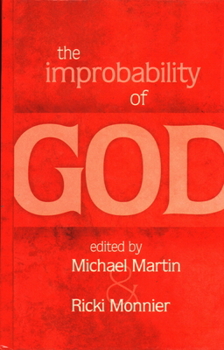
The Improbability of God

A growing number of powerful arguments have been formulated by philosophers and logicians in recent years demonstrating that the existence of God is improbable. These arguments assume that God's existence is possible but argue that the weight of the empirical evidence is against God's actual existence. This unique anthology collects most of the important arguments for the improbability of God that have been published since the mid-1900s. The editors make each argument clear and accessible by providing a helpful summary. In addition, they arrange this diverse collection of arguments for the improbability of God into four thematic groups: Part 1 contains cosmological arguments based on the weight of the evidence relative to the origin of the universe; Part 2 presents teleological arguments based on the weight of the evidence relative to the order in the universe; Part 3 deals with inductive evil arguments based on the weight of the evidence relative to the widespread and horrendous evil in the world; and Part 4 contains nonbelief arguments based on the weight of the evidence relative to the widespread nonbelief or the reasonable nonbelief in the world. The list of distinguished authors includes William Rowe, Theodore Drange, Quentin Smith, Victor Stenger, J. L. Schellenberg, and Michael Martin, among others. With this new anthology as a companion to their earlier anthology, The Impossibility of God (2003), Martin and Monnier have created an indispensable resource in the philosophy of religion.
Format:Hardcover
Language:English
ISBN:1591023815
ISBN13:9781591023814
Release Date:February 2006
Publisher:Prometheus Books
Length:434 Pages
Weight:1.65 lbs.
Dimensions:1.2" x 6.3" x 9.0"
Customer Reviews
5 ratings
The Hobo Philosopher
Published by Thriftbooks.com User , 18 years ago
Herbert Spenser once said that since "God" can neither be proven or disproved the only realistic position for the intelligent man is "agnosticism". The True atheist claims this position is a "cop-out". I would say that this is a book that is making the attempt not to cop out. This is not for the idle reader; this book is a sophisticated in depth study. The two men who put this book together did their homework. If this is a serious subject to you and not simply a partisan argument or a personal attempt at apologetics, this is a book for you. I imagine the audience for this book is very limited. This book is not for the weak of mind or the simplistic. You won't read this book in a week, or a month or a year. This is a continuous lifelong study. It is a text not a dialogue. It deals with specific arguments and takes one argument at a time. This could be used at a university in a course in traditional logic. I don't remember exactly but I think that I spent $30 for this book. I have no regrets about that purchase.
Brilliant brain candy!
Published by Thriftbooks.com User , 21 years ago
This is one of those rare philosophy books that must be read with a highlight pen in hand. I had a hard time putting it down, reading it rather incongruously through my Christmas holiday. While savoring it, thoughtful readers will no doubt also be inspired to create their own parallel arguments. The arguments are mainly applicable to an omniscient, omnipotent, all-loving God. Most Christians will simply retrench into a watered down version of God rather than truly be swayed against belief per se, without worrying about if such a tepid deity is worthy of belief and devotion anyway. Nevertheless, as an exercise in logic- of the rather ultimate sort- The Impossibility of God is undeniably fascinating and thought provoking.
Atheology 101
Published by Thriftbooks.com User , 21 years ago
The Impossibility of God is a wonderful compilation of potent arguments against the existence of God. That is, a God defined in a way that defies logic and reason. The book accomplished what it intended, showing the Impossibility of God. I certainly recommend this book as being a vigorous, entertaining and up-to-date refutation of the figment of man's imagination (the existence of God).
The Breathtaking Perversity of Theists
Published by Thriftbooks.com User , 21 years ago
The reviewer dmitri works himself into a lather attempting to dissuade the reader from becoming an atheist. Since I am feeling feisty right now and am taking a break from writing a paper, I will address some of his laughable reasons adduced for that purpose. dmitri asserts that the authors of this fine text are cocksure because they believe that God exists in no possible world. He goes on to say that there is a small chance that God does exist. Clearly that is begging the question, since the issue at hand is whether or not there is a small chance that God exists. If dmitri disagrees with the authors, then perhaps he should specify which arguments he finds unsound and why he finds them so. I can assure you that any attempt on his part would have to possess more content than the drivel that he did in fact type. Criticizing the general strategy of proving that a being does not exist is absurd, since this sort of argumentation occurs daily and with great success in philosophy departments across the country. dmitri appeals to Pascal's Wager as well. That this argument is still used by theists is fine evidence that the foundations of theism are on the verge of collapsing--it is a desperate final attempt to get the trained intellect to believe despite the mountain of evidence against theism. If you are convinced by the wager, I have a nearby bridge to sell you. dmitri also recommends the books by C.S. Lewis and Lee Strobel. Unfortunately these two men have the philosophic intelligence of Baptist youth ministers. Please see S.T. Joshi's book God's Defenders for a hilarious criticism of Lewis's buffoonery. Strobel, I trust, can be exposed as a sophist within a few minutes of careful reading. So we see that dmitri proposed no good reasons for his contempt for Martin's book and atheism in general. But sadly, dmitri is a token of a type--the pseudo-intellectual Christian. Watch out for this sort. Far more dangerous that the typical religious dolt.
A DEIST REVIEW
Published by Thriftbooks.com User , 21 years ago
As Dennis Littrell earlier put it, the authors of Impossibility of God "come close" to proving that all definitions of God are inadequate. If he is wrong and the authors in fact did demonstrate the inadequacy of the definitions, what then? If that is the case, one does not need to disprove God since the very definitions fail to establish such a being in the first place! One need not note that contradictions exist. All we need do is point out that the definitions of God simply fail, therefore, the onus (as it has always been) falls on the theist to prove God exists. Atheists have to prove and disprove nothing. If no definition of God is adequate to prove God, further arguments for or against are ridiculous. The question remains: did this book adequately demonstrate that there is no adequate definition of God. Read it and judge for yourself instead of taking my word or the word of Dennis Littrell or anyone else!
Copyright © 2026 Thriftbooks.com
Terms of Use | Privacy Policy | Do Not Sell/Share My Personal Information | Cookie Policy | Cookie Preferences | Accessibility Statement
ThriftBooks ® and the ThriftBooks ® logo are registered trademarks of Thrift Books Global, LLC
ThriftBooks ® and the ThriftBooks ® logo are registered trademarks of Thrift Books Global, LLC
