


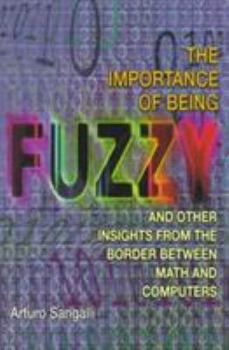
The Importance of Being Fuzzy: And Other Insights from the Border Between Math and Computers

Select Format
Select Condition 
Book Overview
How has computer science changed mathematical thinking? In this first ever comprehensive survey of the subject for popular science readers, Arturo Sangalli explains how computers have brought a new practicality to mathematics and mathematical applications. By using fuzzy logic and related concepts, programmers have been able to sidestep the traditional and often cumbersome search for perfect mathematical solutions to embrace instead solutions that are "good enough." If mathematicians want their work to be relevant to the problems of the modern world, Sangalli shows, they must increasingly recognize "the importance of being fuzzy."
As Sangalli explains, fuzzy logic is a technique that allows computers to work with imprecise terms--to answer questions with "maybe" rather than just "yes" and "no." The practical implications of this flexible type of mathematical thinking are remarkable. Japanese programmers have used fuzzy logic to develop the city of Sendai's unusually energy-efficient and smooth-running subway system--one that does not even require drivers. Similar techniques have been used in fields as diverse as medical diagnosis, image understanding by robots, the engineering of automatic transmissions, and the forecasting of currency exchange rates. Sangalli also explores in his characteristically clear and engaging manner the limits of classical computing, reviewing many of the central ideas of Turing and Godel. He shows us how "genetic algorithms" can solve problems by an evolutionary process in which chance plays a fundamental role. He introduces us to "neural networks," which recognize ill-defined patterns without an explicit set of rules--much as a dog can be trained to scent drugs without ever having an exact definition of "drug." Sangalli argues that even though "fuzziness" and related concepts are often compared to human thinking, they can be understood only through mathematics--but the math he uses in the book is straightforward and easy to grasp. Of equal appeal to specialists and the general reader, The Importance of Being Fuzzy reveals how computer science is changing both the nature of mathematical practice and the shape of the world around us.Format:Hardcover
Language:English
ISBN:0691001448
ISBN13:9780691001449
Release Date:November 1998
Publisher:Princeton University Press
Length:200 Pages
Weight:1.11 lbs.
Dimensions:0.9" x 6.4" x 9.6"
Customer Reviews
5 ratings
an introduction to fuzzy logic, genetic algorithms and more
Published by Thriftbooks.com User , 20 years ago
The Importance of Being Fuzzy is a book not just about fuzzy logic but also genetic algorithms and the limits of computers. I found the introductory chapters on fuzzy logic to be accessible but found later chapters very hard to follow. I think this is because the author attempts to go to a depth not really appropriate for the general audience this book is meant for. For example the chapter on the limits of computers could be the subject of a whole book and would need to be to be adequately explained. Still this book is worth reading for it's depictions of the many successful uses that fuzzy logic has been put to.
Great intro to fuzzy logic, computability, neural nets, & GA
Published by Thriftbooks.com User , 24 years ago
After reading this book, I would echo the mostly positive reviews of this book offered by others below. As noted by others, *The Importance of Being Fuzzy* is an accessible intro to fuzzy logic, issues surrounding the limitations of computability (Godel/Turing/NP-completeness), neural networks, and genetic algorithms.Arturo Sangalli tries to give just enough of a taste of the technical details of the topics mentioned above to balance the need to be accessible without dumbing things down too much. Sangalli writes about the theoretical, historical, and applicability issues surrounding so-called *soft computing* (fuzzy logic, etc.).One of the things I found interesting about Sangalli's writing style is that he writes very efficiently. By that I mean that he manages to discuss all of the very complicated concepts mentioned above in a succinct and efficient way without losing clarity and accessibility. He included 4 brief appendixes dealing with various concepts mentioned in the main text in a more formal way (for those who are interested).In short this book is by far the most accessible account of fuzzy logic, NP-completeness, neural networks, and genetic algorithms. Fortunately, this reader-friendliness does NOT come at the price of having a dumbed down account. [As for Godel/Turing computability issues, there are a variety of other contenders for accessible accounts (e.g., *Godel, Escher, Bach*).] No wonder this book won the 1998 Association of American Publishers Award for Best Professional/Scholarly Book in Computer Science.Finally, I take issue with the hostile review from Ontario, Canada. The obvious purpose of this book is to offer an intelligent yet readable introduction to *soft computing* issues. It is completely unfair to bash this book because it does not engage in a sufficient degree of name-dropping. In fact, one piece of name-dropping by the hostile reviewer -- his complaint that the book did not mention Gregory Chaitin -- is really off-base since there really is no need in a book like this to deal with AIT/Kolmogrov complexity [the limits of computability issues can be dealt with sufficiently by citing Godel/Turing/Church and NP-completeness]. I strongly believe that the merits of a book should be based on rational criteria and not on tangential issues.
Wonderful
Published by Thriftbooks.com User , 26 years ago
After floundering trying to understand abstract computer science issues such as computability, NP-complete, Turing machines, with very basic math skills, I came across this book. I thought it would just introduce concepts of fuzzy logic, neural nets, and genetic programming. Pleasantly surprised that, in doing the above, the fundamental concepts are quite lucidly explained. A real mathematician would be disappointed with the lack of full proofs and mathematical rigor, but for the non- or novice mathhead, this is a wonderful find.
Complexity made simple
Published by Thriftbooks.com User , 26 years ago
This is a wonderful little book. Not only does it describe fuzzy logic clearly, it also covers other fascinating areas of math/computer science such as the traveling salesman problem, computational complexity, and genetic algorithms. I learned a tremendous amount by reading it. It's very well written and a must-buy for anyone who wonders what's going on in cutting-edge math.
Where Fuzzy is Clear
Published by Thriftbooks.com User , 27 years ago
If you want to find out how a computer works, you won't get much help by taking a look under the cover. What you see is a floor of chips, a maze of wires and a little fan to keep things cool - not a pretty sight, but then neither is the box itself. When Steve Jobs decided to colour his iMACs and use transparent perspex so that we can see the innards, he was responding to this drab ugliness with a touch of rouge and a dab of eye shadow. Ultimately however, if you want to find the soul of the computer, what makes it fast or slow, clever or stupid, efficient or a nuisance, you will have to get inside its mathematics. Most people know that the mathematics behind computers has something to do with binary arithmetic and things called bits and bytes and logic gates. What they may not know is that there is a well-established science of computability; it even has its own Einstein in the person of the tragic English genius Alan Turing. In this book, Canadian academic Arturo Sangalli describes Turing's work, and examines three mathematical techniques which modern research is using in attempts to make computers more efficient and possibly more intelligent. All three approaches started life as esoteric mathematical ideas and lay dormant for some time before computer researchers began to use them. The most interesting and most easily understood is what is known as fuzzy logic. This may seem like a contradiction in terms, but as Sangalli points out, it is a logic of fuzziness, not a logic which is itself fuzzy. In its broadest sense, it is synonymous with the mathematical theory of fuzzy sets. The concept of a Set was one of the core elements of the New Maths of the 1970s which many parents will gratefully recall as the excuse they were able to give for not being able to help their children with school mathematics. I won't try to change that situation at this late stage, beyond saying that a set has to be precisely determined - you cannot have vaguely defined sets like "tall people" or "funny television programs" or "interesting books." The mathematical theory of fuzzy sets was taken down from the shelf and dusted off some years ago by computer engineers, particularly in Japan where the government persuaded a consortium of local heavies - Matsushita, Canon, Hitachi, and Mitsubishi among others - to invest $50 million in the Laboratory for International Fuzzy Engineering Research (LIFE). The result has been that most electronic goods now produced in Japan contain what an advertisement currently running on television calls "fuzzy thingys."To give an idea of how fuzziness is used in computer programs, consider the way a child balances a stick upright on the palm of one hand. The feat requires a complex combination of movements and adjustments and feedback. How can a computer be taught to do the trick? What computer engineeres have done is to construct a mechanical model controlled by a computer which has been programmed with
Copyright © 2026 Thriftbooks.com
Terms of Use | Privacy Policy | Do Not Sell/Share My Personal Information | Cookie Policy | Cookie Preferences | Accessibility Statement
ThriftBooks ® and the ThriftBooks ® logo are registered trademarks of Thrift Books Global, LLC
ThriftBooks ® and the ThriftBooks ® logo are registered trademarks of Thrift Books Global, LLC
