


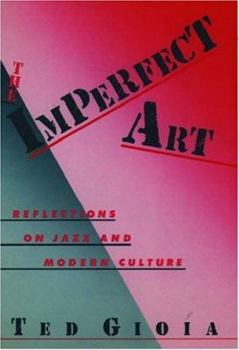
The Imperfect Art: Reflections on Jazz and Modern Culture

Select Format
Select Condition 
Book Overview
By the 1930s, the radio and phonograph had transformed the experience of music in America from unique, live performances to the repetitive playing or broadcasting of records. In an age of mechanical reproduction, music was everywhere, but as Ted Gioia points out in this brilliant new volume, its impact was watered down, debased. It had become, in Erik Satie's words, "furniture music." Jazz, according to Gioia, stands opposed to this dehumanizing trend, emphasizing improvisation and the human element (the performer) over the work of art. Taking a wide-ranging approach rare in jazz criticism, Gioia draws upon fields as disparate as literary criticism, art history, sociology, and aesthetic philosophy as he places jazz within the turbulent cultural environment of the 20th century. The book can be read on several levels: as a history of jazz and a study of its major figures; as a critique of major schools of thought, such as minimalism, deconstruction, and primitivism; as an attempt to define precise standards of good and bad in jazz; and as a meditation on the possibility of improvised art. Gioia argues that because improvisation--the essence of jazz--must often fail under the pressure of on-the-spot creativity, jazz should be seen as an "imperfect art" and judged by an "aesthetics of imperfection," which he outlines in a key chapter. Incorporating the thought of such seminal thinkers as Walter Benjamin, Jose Ortega y Gasset, and Roland Barthes, The Imperfect Art is a feast for the thoughtful jazz afficionado, filled with vivid portraits of the giants of jazz and with startling insight into this vital musical form and the interaction of society and art."
Format:Hardcover
Language:English
ISBN:0195053435
ISBN13:9780195053432
Release Date:June 1988
Publisher:Oxford University Press
Length:140 Pages
Weight:0.70 lbs.
Dimensions:8.4" x 0.7" x 5.8"
Customer Reviews
1 rating
This book should not be forgotten
Published by Thriftbooks.com User , 17 years ago
I first read 'The Imperfect Art' nearly 20 years, and if the book didn't change my life, it certainly changed my thinking about a bunch of stuff - like what it means to be creative, and what it means - as a listener - to go along for the ride. The book is about jazz and how it 'works,' but that's just Gioia's jumping off point. It is every bit as rigorous in its reasoning as formal, academic works - but it's also highly readable, a gift of deep thinking couched in every day language. Ted Gioia went on to write several other fine books about jazz and related musics, but this one - his first - is my favorite. It's an essay you can return to time and again and get something new out of it. I look forward to reading it for the rest of my life.
Copyright © 2026 Thriftbooks.com Terms of Use
| Privacy Policy | Do Not
Sell/Share My Personal Information | Cookie Policy | Cookie Preferences | Accessibility Statement
ThriftBooks® and the ThriftBooks® logo are registered trademarks of Thrift Books Global, LLC
ThriftBooks® and the ThriftBooks® logo are registered trademarks of Thrift Books Global, LLC
