


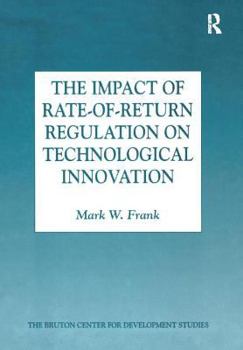
The Impact of Rate-Of-Return Regulation on Technological Innovation
No Customer Reviews

This book contends that various forms of regulation have costs as well as benefits and it examines the impact of government regulation on the innovativeness of 'monopolies' - in this book meaning firms with the power to affect market price. The government regulation analyzed in this case is limited to rate-of-return regulation. Using theoretical models such as the Averch-Johnson model and a two-stage Nash equilibrium model, this volume examines whether regulated monopolies engage in more or less technological innovation than unregulated monopolies. Furthermore, if the unregulated (or less regulated) monopolies do engage in more research and development than regulated ones, it questions whether social welfare would be greater with the former. Using a case study of ten privately-owned electric utilities in the State of Texas, USA, it then tests out the general propositions brought forward by the theoretical modelling and finally makes its conclusions taking into consideration both theoretical and empirical findings.
Format:Paperback
Language:English
ISBN:1138263850
ISBN13:9781138263857
Release Date:April 2017
Publisher:Routledge
Length:146 Pages
Weight:0.48 lbs.
Dimensions:0.3" x 5.8" x 8.5"
Customer Reviews
0 rating
Copyright © 2026 Thriftbooks.com
Terms of Use | Privacy Policy | Do Not Sell/Share My Personal Information | Cookie Policy | Cookie Preferences | Accessibility Statement
ThriftBooks ® and the ThriftBooks ® logo are registered trademarks of Thrift Books Global, LLC
ThriftBooks ® and the ThriftBooks ® logo are registered trademarks of Thrift Books Global, LLC
