


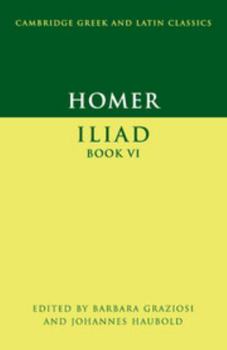
Homer: Iliad Book VI

Select Format
Select Condition 
Book Overview
The sixth book of the Iliad includes some of the most memorable and best-loved episodes in the whole poem: it holds meaning and interest for many different people, not just students of ancient Greek. Book 6 describes how Glaukos and Diomedes, though fighting on opposite sides, recognise an ancient bond of hospitality and exchange gifts on the battlefield. It then follows Hector as he enters the city of Troy and meets the most important people in his life: his mother, Helen and Paris, and finally his wife and baby son. It is above all through the loving and fraught encounter between Hector and Andromache that Homer exposes the horror of war. This edition is suitable for undergraduates at all levels, and students in the upper forms of schools. The Introduction requires no knowledge of Greek and is intended for all readers interested in Homer.
Format:Paperback
Language:English
ISBN:0521703727
ISBN13:9780521703727
Release Date:November 2010
Publisher:Cambridge University Press
Length:290 Pages
Weight:0.84 lbs.
Dimensions:0.6" x 5.4" x 8.4"
Customer Reviews
1 rating
The ground is dark with blood.
Published by bernie4444 , 3 months ago
With many books, translations are negligible, with two obvious exceptions: one is the Bible, and surprisingly, the other is The Iliad. Each translation can give a different insight and feel to the story. Everyone will have a favorite. I have several.
There are partial translations that are worth reading, but as with any abridgment or incomplete Iliad, you will never know what is missing.
Be aware of retold versions, as the purpose of the original can be twisted or lost altogether.
Our story takes place in the ninth year of the ongoing war. We get some introduction to the first nine years, but they are just a background to this tale of pride, sorrow, and revenge. The story will also end abruptly before the end of the war.
We have a wide conflict between the Trojans and Achaeans over a matter of pride; the gods get to take sides and many times direct spears and shields.
Although the more focused conflict is the power struggle between two different types of power. That of Achilles, son of Peleus and the greatest individual warrior, and that of Agamemnon, lord of men, whose power comes from his position.
We are treated to a blow-by-blow inside story as to what each is thinking and an unvarnished description of the perils of war and the search for Arête (to be more like Aries, God of War).
Next, before reading the Odyssey, you will want to bridge the gap with “The War at Troy: What Homer Didn't Tell” by Quintus of Smyrna.
Copyright © 2026 Thriftbooks.com
Terms of Use | Privacy Policy | Do Not Sell/Share My Personal Information | Cookie Policy | Cookie Preferences | Accessibility Statement
ThriftBooks ® and the ThriftBooks ® logo are registered trademarks of Thrift Books Global, LLC
ThriftBooks ® and the ThriftBooks ® logo are registered trademarks of Thrift Books Global, LLC
