


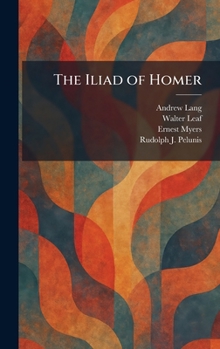
The Iliad of Homer

Select Format
Select Condition 
Book Overview
"The Iliad of Homer" is one of the foundational works of Western literature and a cornerstone of the epic tradition. Attributed to the ancient Greek poet Homer, this monumental poem recounts the final weeks of the Trojan War, a legendary decade-long conflict between the city of Troy and the Achaean forces. The narrative is driven by the theme of the wrath of Achilles, the Greeks' most formidable warrior, whose pride and subsequent withdrawal from the battlefield lead to devastating consequences for his comrades.
This translation, produced by the noted scholars Andrew Lang, Walter Leaf, and Ernest Myers, seeks to capture the archaic beauty and heroic scale of the original Greek text. Through its verses, readers encounter a world where the destinies of men are intricately woven with the whims of the Olympian gods. From the fierce duels on the plains of Troy to the moving encounters between legendary figures like Hector and Priam, "The Iliad of Homer" explores universal human experiences: the pursuit of glory, the agony of loss, and the inevitability of fate. It remains an essential read for anyone seeking to understand the roots of epic storytelling and the enduring power of classical mythology.
This work has been selected by scholars as being culturally important, and is part of the knowledge base of civilization as we know it. This work was reproduced from the original artifact, and remains as true to the original work as possible. Therefore, you may see the original copyright references, library stamps (as most of these works have been housed in our most important libraries around the world), and other notations in the work.
This work is in the public domain in the United States of America, and possibly other nations. Within the United States, you may freely copy and distribute this work, as no entity (individual or corporate) has a copyright on the body of the work.
As a reproduction of a historical artifact, this work may contain missing or blurred pages, poor pictures, errant marks, etc. Scholars believe, and we concur, that this work is important enough to be preserved, reproduced, and made generally available to the public. We appreciate your support of the preservation process, and thank you for being an important part of keeping this knowledge alive and relevant.
Customer Reviews
The ground is dark with blood.
ThriftBooks® and the ThriftBooks® logo are registered trademarks of Thrift Books Global, LLC
