


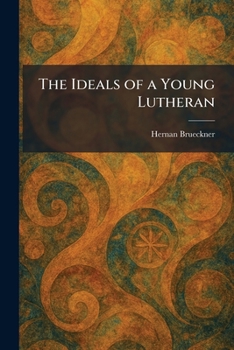
The Ideals of a Young Lutheran

"The Ideals of a Young Lutheran" is a thoughtful exploration of the spiritual and moral framework intended to guide young individuals within the Lutheran faith. Written by Rev. Herman Brueckner, the work serves as a comprehensive manual for living a life of purpose, integrity, and devotion. It delves into the specific virtues and character traits that define a committed Christian life, providing a roadmap for navigating the transitions from adolescence to adulthood with a firm religious foundation.
The text emphasizes the practical application of Lutheran doctrine to everyday challenges, focusing on the development of a robust inner life and an outward commitment to service. Through its discussion of "ideals," the book seeks to inspire readers toward higher standards of conduct and a deeper understanding of their role within the church and the broader community. As a significant piece of early twentieth-century religious literature, it offers valuable insights into the pedagogical methods used to instill faith and discipline in the youth of the era. This work remains a compelling resource for those interested in the history of Protestant spiritual formation and the enduring principles of Lutheran ethics.
This work has been selected by scholars as being culturally important, and is part of the knowledge base of civilization as we know it. This work was reproduced from the original artifact, and remains as true to the original work as possible. Therefore, you may see the original copyright references, library stamps (as most of these works have been housed in our most important libraries around the world), and other notations in the work.
This work is in the public domain in the United States of America, and possibly other nations. Within the United States, you may freely copy and distribute this work, as no entity (individual or corporate) has a copyright on the body of the work.
As a reproduction of a historical artifact, this work may contain missing or blurred pages, poor pictures, errant marks, etc. Scholars believe, and we concur, that this work is important enough to be preserved, reproduced, and made generally available to the public. We appreciate your support of the preservation process, and thank you for being an important part of keeping this knowledge alive and relevant.
Customer Reviews
ThriftBooks ® and the ThriftBooks ® logo are registered trademarks of Thrift Books Global, LLC
