


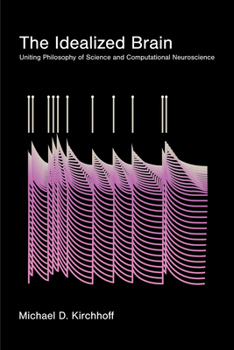
The Idealized Brain: Uniting Philosophy of Science and Computational Neuroscience
No Customer Reviews

A critical look at our modeling techniques, and what idealized modeling can tell us, if anything, about the mind and brain. In The Idealized Brain, Michael Kirchhoff explores the challenges of using idealized modeling in computational neuroscience. The book spans work on neural coding, deep learning, machine learning, AI, philosophy of cognitive science, and philosophy of science. The author addresses many of the epistemic uses and harms of idealization across multiple scales and paradigms--from early biophysical models, information theory, neural coding, and deep convolutional neural networks to explainable AI--highlighting connections that should have far-reaching consequences for both philosophy of cognitive science, methodology in computational neuroscience, and how we communicate the results of our research. Kirchhoff argues that we need to place approximation methods such as idealization at the heart of our discussions in computational neuroscience, philosophy of neuroscience, philosophy of cognitive science, and philosophy of mind. Only then can we make progress to ensure that our interpretations of computational modeling of the mind and brain are robust and on a secure epistemic and metaphysical footing.
Format:Paperback
Language:English
ISBN:0262054922
ISBN13:9780262054928
Release Date:December 2026
Publisher:MIT Press
Length:268 Pages
Customer Reviews
0 rating
Copyright © 2026 Thriftbooks.com
Terms of Use | Privacy Policy | Do Not Sell/Share My Personal Information | Cookie Notice | Cookie Preferences | Accessibility Statement
ThriftBooks ® and the ThriftBooks ® logo are registered trademarks of Thrift Books Global, LLC
ThriftBooks ® and the ThriftBooks ® logo are registered trademarks of Thrift Books Global, LLC
