


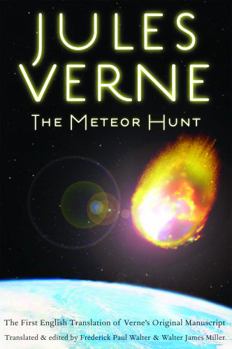
The Meteor Hunt: The First English Translation of Verne's Original Manuscript


Select Format
Select Condition 
Book Overview
The Meteor Hunt marks the first English translation from Jules Verne's own text of his delightfully satirical and visionary novel. While other, questionable versions of the novel have appeared--mainly, a significantly altered text by Verne's son Michel and translations of it--this edition showcases the original work as Verne wrote it. The Meteor Hunt is the story of a meteor of pure gold careening toward the earth and generating competitive greed among amateur astronomers and chaos among nations obsessed with the trajectory of the great golden object. Set primarily in the United States and offering a humorous critique of the American way of life, The Meteor Hunt is finally given due critical treatment in the translators' foreword, detailed annotations, and afterword, which clearly establish the historical, political, scientific, and literary context and importance of this long-obscured, genre-blending masterpiece in its true form.
Format:Paperback
Language:English
ISBN:0803296347
ISBN13:9780803296343
Release Date:October 2006
Publisher:Bison Books
Length:232 Pages
Weight:0.50 lbs.
Dimensions:0.7" x 5.4" x 7.9"
Customer Reviews
2 ratings
A book by Jules and Michel Verne, Father and Son
Published by Thriftbooks.com User , 23 years ago
It's happened again. A reputable publisher, Bison Books, distributed through the University of Nebraska Press, has attractively reprinted a Jules Verne book whole from the first British edition, on that basis calling it unabridged. Yet there is no acknowledgment of two fundamental facts: it is (of course) a translation from the French, and, most importantly, it is not derived from the actual text written by Jules Verne.Presumably Bison Books decided to reprint this little-known Verne novel in the same year that brought DEEP IMPACT and ARMAGEDDON into movie theaters. The Chase of the Golden Meteor contains a refreshing variation on this particular science fiction theme, one far different from the rather trite disaster formula the cinema has brought us. On the positive side, Bison's reprint of the 1909 Grant Richards text published in London wisely retains 23 of the original 35 illustrations by George Roux from the French editions. Although never crediting the artist, the capable reproductions of the Roux illustrations make The Chase of the Golden Meteor one of the most visually pleasing Verne paperbacks to have appeared in years.Unfortunately, nowhere in Bison's volume is any comment to be found on essential textual topics. There is no mention of the translator or what kind of work s/he did; as the enhancement of the title from La Chasse au météore to The Chase of the Golden Meteor indicates, this is an imprecise translation, rearranging paragraphs, cutting numerous adjectives and sometimes whole sentences according to the translator's whim.Even more significant is the fact that The Chase of the Golden Meteor was translated from one of the seven posthumously published Verne novels that were guided into print by the author's son, Michel. For many years, the Verne family argued that Michel's changes did not go beyond stylistic polishing, updating, or possible verbal instructions from father to son. However, once the evidence became public over twenty years ago, what even Verne's original publisher had known was clear. Michel substantively altered all the works posthumously published under his father's name, in both minor and major ways, even originating two of the books himself.Jules Verne had dealt with "outer space" twice before in his novels, in the duo of De la terre à la lune (From the Earth to the Moon, 1865) and Autour de la lune (Around the Moon, 1870), and in Hector Servadac (1877). The original ending of Hector Servadac had the comet Gallia impacting the Earth in the Caspian Sea, which swallowed it with minimal affect on the planet, despite widely anticipated destruction and global panic. However, Gallia proves to be 30% gold, turning it from a scarce into a plentiful mineral, and diminishing the value of gold reserves. Verne's publisher, Pierre-Jules Hetzel, compelled a rewriting that eliminated this climax, and Verne waited over twenty years to expand the idea suppressed by the elder Hetzel (who had since died) into a full-length novel
A Nice Little Book
Published by Thriftbooks.com User , 23 years ago
While this book may not be a masterpiece of science fiction, it is quite enjoyable. To be honest, it has been more than a year since I read the book, but I remember that I started reading it when I went to bed around midnight from where I had left off the night before and I had more than half the book left to read. That night I could not go to sleep until I finished the book, simply because I had to know how it ended (excuse me for being a bit vague but I don't want to give anything away to anyone who might want to read the book). This book may appeal more to children, in that the ideas are somewhat beyond the realm of the possible, but it is still enjoyable to any open minded adult, especially if you like to read to your kids. The beginning of the book starts out slow, focusing on several different characters who at one point or another have some interest in the meteor, but are pushed aside by the middle of the book and all but forgotten. The "greed" of governments may not be the real issue, or at least it is not the only issue, as the author points out that the extreme value of the meteor, if not distributed correctly, could destroy any of the economies of the world. I think I've already given too much away, so I'll stop here. To sum it all up, it is a nice little book to read, so don't be discouraged by some negative comments made by others, give it a chance and decide for yourself.
Copyright © 2026 Thriftbooks.com Terms of Use
| Privacy Policy | Do Not
Sell/Share My Personal Information | Cookie Policy | Cookie Preferences | Accessibility Statement
ThriftBooks® and the ThriftBooks® logo are registered trademarks of Thrift Books Global, LLC
ThriftBooks® and the ThriftBooks® logo are registered trademarks of Thrift Books Global, LLC
