


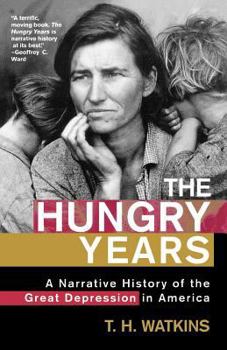
The Hungry Years: A Narrative History of the Great Depression in America


Select Format
Select Condition 
Book Overview
It was the worst of times and the best of times. It was an era of unprecedented crisis and a time of unprecedented courage. In a single, comprehensive volume, The Hungry Years tells the story of the Great Depression through the eyes of the people who lived it. Less concerned with the power brokers in Washington than with the daily struggles of ordinary people at the grassroots across America, it draws on little-known oral histories, memoirs, local press, and scholarly monographs to capture the voices of men and women in a time of extreme crisis. The result is a richly detailed narrative that traces the stages of the disaster chronologically without losing touch with the personal wounds it inflicted or the ways in which people responded. Humane and compassionate, brilliantly researched, full of story and anecdote, The Hungry Years puts the reader at the very heart of the maelstrom that was the American depression.
Format:Paperback
Language:English
ISBN:0805065067
ISBN13:9780805065060
Release Date:September 2000
Publisher:St. Martins Press-3PL
Length:608 Pages
Weight:1.24 lbs.
Dimensions:1.7" x 5.5" x 8.4"
Related Subjects
20th Century Business Business & Investing History Modern (16th-21st Centuries) WorldCustomer Reviews
1 rating
skilled narrative history at its lyrical, absorbing best
Published by Thriftbooks.com User , 25 years ago
We live in an era in which politicians of both major parties try to outdo each other in their denunciations of government. President Reagan provided the verbal apotheosis of this anti-goverrnmental attitude, and his accolyte, George W. Bush, a political insider if there ever was one, continues the cynical and insidious calculated assault on the nature of government and its relationship with the people. Many Americans today feel a profound alienation from government and truly believe their interests are contradictory of those of government. T. H. Watkins, author of the elegant, compelling and profound history of the Great Depression, "The Hungry Years" must wince every time he hears these voices. Professor Watkins knows of another time in our past, one of great social dislocation and mass suffering; one where men and women yearned for work and from work, hope; one where the threads which bound us together as a nation were slowly, but steadily, fraying. His remarkably beautiful and tremendously affecting work stands as a reminder that there was a time in our not too distant past where one man, crippled and conflicted himself, sought to alleviate that suffering in a program which would redefine a citizen's relationship with his or her national government."The Hungry Years" above all serves as a philosophical keystone that Franklin Delano Roosevelt and the New Deal sought to change governmental indifference into governmental action, attempted to create a symbiotic and caring relationship between the common person and government, and served to remind all Americans that activism in the name of justice and dignity is a pivotal characteristic in our national character. Watkins clearly analyzes the myriad of dreams, laws, acts, decisions and outcomes of the New Deal, and he is frank in discussing shortfalls and disappointments. Underlying the discussion, however, is his unabashed admiration for the tenor of the early years of FDR's adminstration. "For a time, millions of Americans -- white, black, and brown, male and female, urban and rural, young and old, white-collar and blue-collar -- had been given a sense of their own worth and power, the notion that by joining together they could control at least some portion of their lives, however imperfectly, however briefly."This admirable volume rings with authenticity, primarily because the author so assiduously assembled anecdotes and interviews with those directly affected by the Great Depression. Human voices, laden with sadness and anger, ringing with rage at loss and suffering and growling with the ominous timbre of class war, appear on every page. These voices, magnificently interstitched with careful research (even his footnotes are written gracefully), control the book and serve to focus our attention on the human consequences of the era. Each chapter could stand on its own, but I found his discussion of artists, actors and writers in the New Deal absolutely rivetting, as were his ast
Copyright © 2026 Thriftbooks.com
Terms of Use | Privacy Policy | Do Not Sell/Share My Personal Information | Cookie Notice | Cookie Preferences | Accessibility Statement
ThriftBooks ® and the ThriftBooks ® logo are registered trademarks of Thrift Books Global, LLC
ThriftBooks ® and the ThriftBooks ® logo are registered trademarks of Thrift Books Global, LLC
