


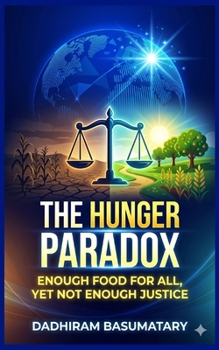
The Hunger Paradox: Enough Food for All, Yet Not Enough Justice
No Customer Reviews

The world produces enough food to feed ten billion people. Eight billion live here. Yet 733 million go to bed hungry tonight. This is not a supply crisis. This is a justice crisis. And if that sentence made you uncomfortable, this book was written for you.
The Hunger Paradox is a relentless, data-driven investigation into the greatest moral contradiction of our era - a planet drowning in agricultural surplus while hundreds of millions starve not for lack of food, but for lack of power. Welness author and food justice researcher Dadhiram Basumatary spent years embedded with smallholder farmers in Nigeria, tribal communities in Odisha, and urban food deserts in Dhaka to answer a single devastating question: Why, in the age of abundance, does hunger still exist?
The answer is not drought. Not overpopulation. Not poor agricultural yield. The answer is a global food system engineered - through trade agreements, land grabs, commodity speculation, and bureaucratic indifference - to keep food profitable while keeping justice out of reach.
Inside this groundbreaking book, you will discover: Why one-third of all food produced globally is wasted every year - enough to feed every hungry person on earth twice over - and who profits from that waste remaining unsolvedHow Brazil reduced food insecurity by more than half in a single decade, and why the world refuses to replicate the modelThe broken biometric scanner in India that legally denied millions their food entitlement - and what it reveals about the architecture of institutional hungerWhy women grow 60-80% of food in sub-Saharan Africa yet own less than 20% of farmland - and how land injustice is the hidden engine of chronic malnutritionHow climate change is not democratically distributed: the people who contributed least to it will lose the most food security because of itWhat Amartya Sen's Nobel Prize-winning research revealed about the relationship between political freedom and famine - and why hunger is always, ultimately, a political choiceThis is not a book about hunger. This is a book about power - who holds it, who is denied it, and what happens to food when justice is absent.
The Hunger Paradox is essential reading for anyone who works in international development, food policy, human rights, climate justice, or global economics - and for every curious reader who suspects that the world's most solvable problem remains unsolved for reasons we are rarely told.
The Hunger Paradox is a relentless, data-driven investigation into the greatest moral contradiction of our era - a planet drowning in agricultural surplus while hundreds of millions starve not for lack of food, but for lack of power. Welness author and food justice researcher Dadhiram Basumatary spent years embedded with smallholder farmers in Nigeria, tribal communities in Odisha, and urban food deserts in Dhaka to answer a single devastating question: Why, in the age of abundance, does hunger still exist?
The answer is not drought. Not overpopulation. Not poor agricultural yield. The answer is a global food system engineered - through trade agreements, land grabs, commodity speculation, and bureaucratic indifference - to keep food profitable while keeping justice out of reach.
Inside this groundbreaking book, you will discover: Why one-third of all food produced globally is wasted every year - enough to feed every hungry person on earth twice over - and who profits from that waste remaining unsolvedHow Brazil reduced food insecurity by more than half in a single decade, and why the world refuses to replicate the modelThe broken biometric scanner in India that legally denied millions their food entitlement - and what it reveals about the architecture of institutional hungerWhy women grow 60-80% of food in sub-Saharan Africa yet own less than 20% of farmland - and how land injustice is the hidden engine of chronic malnutritionHow climate change is not democratically distributed: the people who contributed least to it will lose the most food security because of itWhat Amartya Sen's Nobel Prize-winning research revealed about the relationship between political freedom and famine - and why hunger is always, ultimately, a political choiceThis is not a book about hunger. This is a book about power - who holds it, who is denied it, and what happens to food when justice is absent.
The Hunger Paradox is essential reading for anyone who works in international development, food policy, human rights, climate justice, or global economics - and for every curious reader who suspects that the world's most solvable problem remains unsolved for reasons we are rarely told.
Format:Paperback
Language:English
ISBN:B0GXQYC4YW
ISBN13:9798257910395
Release Date:April 2026
Publisher:Independently Published
Length:202 Pages
Weight:0.45 lbs.
Dimensions:0.4" x 5.0" x 8.0"
Customer Reviews
0 rating
Copyright © 2026 Thriftbooks.com
Terms of Use | Privacy Policy | Do Not Sell/Share My Personal Information | Cookie Policy | Cookie Preferences | Accessibility Statement
ThriftBooks ® and the ThriftBooks ® logo are registered trademarks of Thrift Books Global, LLC
ThriftBooks ® and the ThriftBooks ® logo are registered trademarks of Thrift Books Global, LLC
