


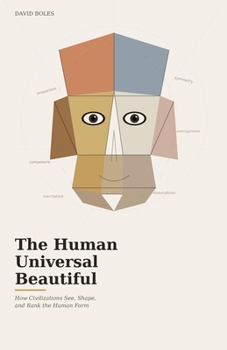
The Human Universal Beautiful: How Civilizations See, Shape, and Rank the Human Form

Beauty is one of the oldest human experiences and one of the least understood. Across every known civilization, human beings have perceived certain forms as possessing a quality that demands attention, admiration, or desire. What changes, radically, is the content poured into that category: which bodies, which faces, which skin colors, which proportions are rewarded with the label "beautiful" and which are denied it.
This book proposes a new framework for understanding that variation. The institutional conversion thesis argues that beauty begins as perception and survives as institution. Human beings arrive with perceptual tendencies that orient attention toward certain configurations of faces and bodies. Those tendencies are then taken up by institutions, religions, empires, schools, markets, technologies, legal systems, and converted into standards with enforcement mechanisms, economic consequences, and social rewards and penalties.
Drawing on evolutionary psychology, art history, race and colonial studies, gender theory, the economics of appearance, the history of cosmetics and body modification, and the emerging scholarship on synthetic imagery, The Human Universal Beautiful traces the conversion process from the infant's first attentive gaze at a symmetrical face through the ancient canons of Greece, Egypt, South Asia, Africa, and Mesoamerica, through the sacred management of beauty in Judaism, Christianity, Islam, Hinduism, and Buddhism, through the racial hierarchies imposed by colonial empires, through the gendered distribution of beauty labor, through the art and media systems that teach beauty across civilizations, through the manufactured body of cosmetics, surgery, and adornment, through the beauty premium in wages, education, and law, to the crisis of provenance created by synthetic imagery in the mid-2020s, when beautiful faces can be generated without any corresponding human body.
The result is the first single-volume work to bind the biological evidence, the cultural analysis, the racial critique, the gender history, the art-historical archive, and the economics of body modification into one governing argument. Beauty connects and instructs, and the question this book answers is who controls the connection and who writes the lesson plan.
Customer Reviews
ThriftBooks ® and the ThriftBooks ® logo are registered trademarks of Thrift Books Global, LLC
