


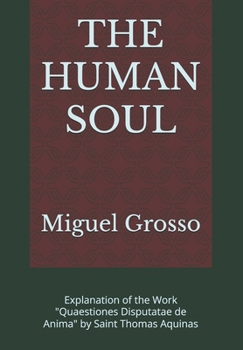
The Human Soul: Explanation of the Work "Quaestiones Disputatae de Anima" by Saint Thomas Aquinas
No Customer Reviews

The Human Soul is a detailed guide to understanding Saint Thomas Aquinas's Quaestiones Disputatae de Anima, shedding light on philosophical and theological questions about the nature of the soul and the unique medieval teaching method: the quaestio disputata. The Method of the Quaestio Disputata The quaestio disputata was at the core of the educational method in 13th-century universities. It consisted of posing a question, analyzing divergent positions, and providing a well-founded answer, promoting critical thinking and rigorous argumentation. This method unfolded in three stages: 1-Lectio: Analytical reading of authoritative texts like Aristotle or the Scriptures.
2-Quaestio: Formulation of a specific question for debate.
3-Disputatio: Formal discussion guided by the master, culminating in a definitive resolution. This approach fostered skills such as critical analysis and well-reasoned defense of ideas, principles still relevant in contemporary education. The Quaestiones Disputatae de Anima Framed within this method, the Quaestiones Disputatae de Anima address the nature of the human soul, tackling essential questions such as: What is the soul? What is its relationship with the body? Is it immortal? These questions resonate today in debates on human identity, the mind, and spirituality. History and authenticity of the work The modern critical edition of this work, led by James H. Robb in the 1960s, was a milestone in scholastic research. Unlike earlier editions, such as the 1570 Rome edition, this version included an analysis of original manuscripts, confirming that the work was recognized as authentic since the late 13th century. While the 1570 edition referred to the work as a single question on the soul, recent research revealed that it originally consisted of 21 questions, showcasing the richness and complexity of Saint Thomas's thought. Content and relevance The core of the work is the relationship between the soul and the body. Influenced by Aristotle and viewed from a Christian perspective, Saint Thomas defines the soul as the substantial form of the body: the vital principle that animates and gives it life. He highlights its immortal and spiritual character as a bridge between the material and the divine. Beyond being the vital principle, the soul is the seat of higher faculties: intelligence and will. These ideas, aimed at addressing both materialism and dualism, remain relevant in current debates on consciousness and identity. Contributions to contemporary thought The analysis of the Quaestiones Disputatae de Anima holds both historical and contemporary value. Its critical method inspires approaches to current issues in neuroscience, psychology, and ethics. Moreover, the Thomistic conception of the soul as a unifying principle contrasts with prevailing reductionist approaches. A book to rediscover Saint Thomas The Human Soul invites readers to rediscover Saint Thomas's thought and the relevance of his method. By exploring topics such as the soul's immortality, its union with the body, and its spiritual dimension, it connects with an intellectual tradition that continues to offer answers and pose essential questions. In sum, this work not only presents the teachings of the Angelic Doctor but also highlights the importance of philosophy and theology for understanding human nature and our place in the world. It is a call to reflect, debate, and seek the truth, just as in medieval disputations.
2-Quaestio: Formulation of a specific question for debate.
3-Disputatio: Formal discussion guided by the master, culminating in a definitive resolution. This approach fostered skills such as critical analysis and well-reasoned defense of ideas, principles still relevant in contemporary education. The Quaestiones Disputatae de Anima Framed within this method, the Quaestiones Disputatae de Anima address the nature of the human soul, tackling essential questions such as: What is the soul? What is its relationship with the body? Is it immortal? These questions resonate today in debates on human identity, the mind, and spirituality. History and authenticity of the work The modern critical edition of this work, led by James H. Robb in the 1960s, was a milestone in scholastic research. Unlike earlier editions, such as the 1570 Rome edition, this version included an analysis of original manuscripts, confirming that the work was recognized as authentic since the late 13th century. While the 1570 edition referred to the work as a single question on the soul, recent research revealed that it originally consisted of 21 questions, showcasing the richness and complexity of Saint Thomas's thought. Content and relevance The core of the work is the relationship between the soul and the body. Influenced by Aristotle and viewed from a Christian perspective, Saint Thomas defines the soul as the substantial form of the body: the vital principle that animates and gives it life. He highlights its immortal and spiritual character as a bridge between the material and the divine. Beyond being the vital principle, the soul is the seat of higher faculties: intelligence and will. These ideas, aimed at addressing both materialism and dualism, remain relevant in current debates on consciousness and identity. Contributions to contemporary thought The analysis of the Quaestiones Disputatae de Anima holds both historical and contemporary value. Its critical method inspires approaches to current issues in neuroscience, psychology, and ethics. Moreover, the Thomistic conception of the soul as a unifying principle contrasts with prevailing reductionist approaches. A book to rediscover Saint Thomas The Human Soul invites readers to rediscover Saint Thomas's thought and the relevance of his method. By exploring topics such as the soul's immortality, its union with the body, and its spiritual dimension, it connects with an intellectual tradition that continues to offer answers and pose essential questions. In sum, this work not only presents the teachings of the Angelic Doctor but also highlights the importance of philosophy and theology for understanding human nature and our place in the world. It is a call to reflect, debate, and seek the truth, just as in medieval disputations.
Format:Paperback
Language:English
ISBN:B0DPSBMZZS
ISBN13:9798302743329
Release Date:December 2024
Publisher:Independently Published
Length:246 Pages
Weight:0.88 lbs.
Dimensions:0.5" x 6.7" x 9.6"
Customer Reviews
0 rating
Copyright © 2025 Thriftbooks.com
Terms of Use | Privacy Policy | Do Not Sell/Share My Personal Information | Cookie Policy | Cookie Preferences | Accessibility Statement
ThriftBooks ® and the ThriftBooks ® logo are registered trademarks of Thrift Books Global, LLC
ThriftBooks ® and the ThriftBooks ® logo are registered trademarks of Thrift Books Global, LLC
