


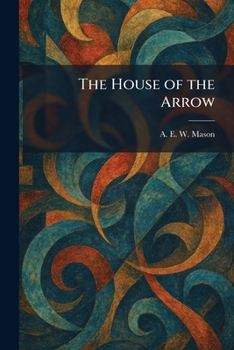
The House of the Arrow

Select Format
Select Condition 
Book Overview
"The House of the Arrow" is a cornerstone of classic detective fiction, featuring the celebrated and astute Inspector Hanaud of the Paris S ret . Set in Dijon, France, the story begins following the death of the wealthy widow Mrs. Harlowe. While her passing initially seems to be from natural causes, an anonymous letter soon surfaces, accusing her niece and heir, Betty Harlowe, of a calculated murder.
Tasked with uncovering the truth, Inspector Hanaud must navigate a complex social web filled with jealousy, suspicion, and hidden motives. The investigation centers on the Harlowe residence, a place where secrets are buried deep and the atmosphere is thick with tension. As the detective meticulously piecing together the clues, the discovery of a mysterious poisoned arrow adds a chilling layer to the puzzle.
Written by A.E.W. Mason, "The House of the Arrow" is renowned for its sophisticated plotting and the brilliant characterization of Hanaud, who served as a significant influence on later fictional detectives. This work represents the height of the Golden Age of mystery, blending psychological depth with a rigorous deductive process that keeps the reader captivated until the final, dramatic revelation.
This work has been selected by scholars as being culturally important, and is part of the knowledge base of civilization as we know it. This work was reproduced from the original artifact, and remains as true to the original work as possible. Therefore, you may see the original copyright references, library stamps (as most of these works have been housed in our most important libraries around the world), and other notations in the work.
This work is in the public domain in the United States of America, and possibly other nations. Within the United States, you may freely copy and distribute this work, as no entity (individual or corporate) has a copyright on the body of the work.
As a reproduction of a historical artifact, this work may contain missing or blurred pages, poor pictures, errant marks, etc. Scholars believe, and we concur, that this work is important enough to be preserved, reproduced, and made generally available to the public. We appreciate your support of the preservation process, and thank you for being an important part of keeping this knowledge alive and relevant.
Customer Reviews
ThriftBooks ® and the ThriftBooks ® logo are registered trademarks of Thrift Books Global, LLC
